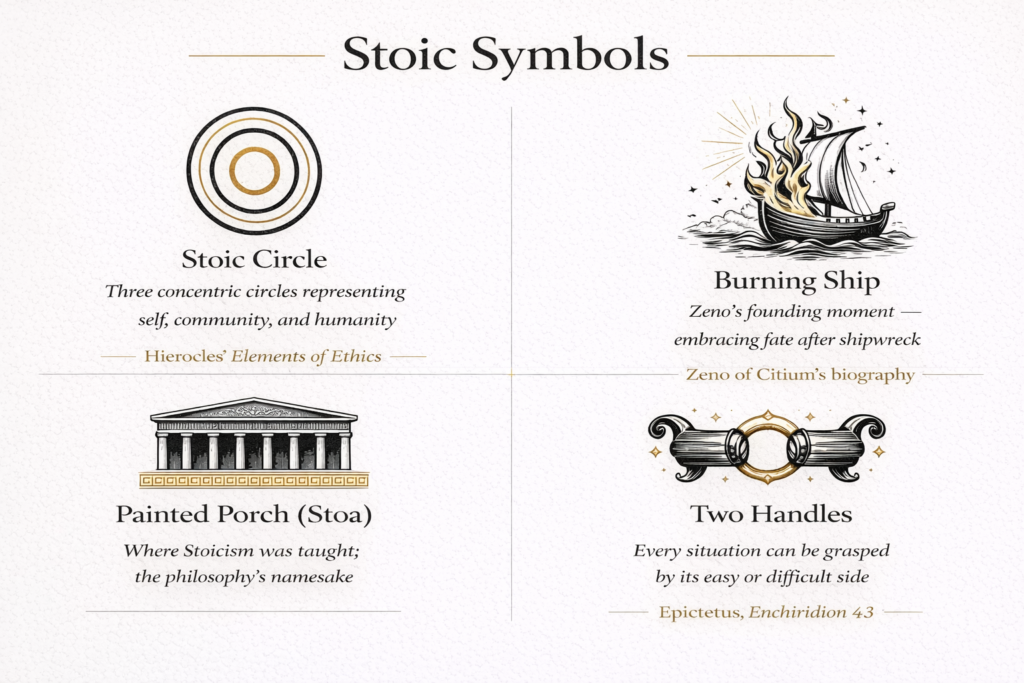
Stoicism is a philosophical tradition concerned with how human beings can live well in a world marked by uncertainty, loss, and limitation. It does not promise escape from difficulty, nor does it attempt to redesign the world according to ideal schemes. Instead, Stoicism focuses on the inner life, on judgment, character, and responsibility. Its central claim is that a good life depends not on external circumstances, but on how one understands and responds to them.
Stoicism emerged in ancient Greece and developed fully in the Roman world, yet its core insights remain strikingly relevant. The tradition addresses enduring human problems: fear, desire, anger, grief, ambition, and the search for meaning. Stoicism offers neither optimism nor pessimism, but realism disciplined by reason.
Below is a clear and systematic explanation of Stoic beliefs, principles, tenets, and values, with each element defined and interpreted within the broader Stoic framework.
Core Stoic Beliefs
The world is governed by reason
Stoicism holds that the world is ordered and intelligible. Events do not occur at random, even when their causes are hidden from us. This does not mean that everything is pleasant or just by human standards, but that reality follows a rational structure. Accepting this order allows the Stoic to replace resentment with understanding.
Human beings are rational and social by nature
Stoics believe that human beings are distinguished by their capacity for reason and by their orientation toward communal life. To live well is to live in accordance with reason while recognizing obligations to others. Isolation and purely private self interest are forms of moral error.
Virtue is the only true good
According to Stoicism, external things such as wealth, health, reputation, and pleasure are not goods in the strict sense. They can be used well or badly. Virtue alone is unconditionally good because it depends entirely on rational character. A person with virtue cannot be harmed in what matters most.
External events are not under our control
A central Stoic belief is that most events lie beyond individual control. Birth, death, illness, social status, and historical circumstances are given conditions, not personal achievements. Suffering often arises from refusing to accept this fact.
Fundamental Stoic Principles
The dichotomy of control
Stoicism draws a sharp distinction between what depends on us and what does not. Our judgments, intentions, values, and choices are within our control. External outcomes are not. Wisdom consists in focusing effort exclusively on what can be governed by reason and letting go of attachment to what cannot.
Living according to nature
To live according to nature means to live in harmony with rational order and with human nature as rational and social. This principle does not refer to instinct or impulse, but to reason properly understood. A life aligned with nature is one guided by clarity rather than passion.
Assent and judgment
Stoicism teaches that emotions are not involuntary forces, but the result of judgments. An external event presents an impression, but the individual chooses whether to assent to it. By examining impressions before accepting them as true, one preserves inner freedom.
Moral responsibility lies in intention
For Stoics, moral worth depends on intention rather than outcome. A good action remains good even if it fails. Conversely, success achieved through vicious intention has no moral value. This principle protects ethical life from dependence on luck.
Central Stoic Tenets
Apatheia or freedom from destructive passions
Apatheia does not mean emotional numbness. It refers to freedom from irrational and excessive passions such as rage, envy, and fear. Stoicism seeks not to suppress emotion, but to transform it through correct judgment.
Ataraxia or inner tranquility
The Stoic ideal of tranquility arises from accepting what cannot be changed and acting rationally where action is possible. This calm is not indifference, but stability grounded in understanding.
Amor fati or acceptance of fate
Stoicism teaches acceptance of events as necessary parts of the whole. This acceptance is active rather than passive. One cooperates with necessity instead of resisting it. Suffering often results from wishing reality to be other than it is.
Impermanence of all externals
Stoics emphasize the transient nature of all external conditions. Everything that can be gained can be lost. Reflecting on impermanence is meant to reduce attachment and prepare the mind for loss without despair.
Cosmopolitanism
Stoicism affirms that all human beings belong to a single moral community. Differences of nationality, status, or culture do not negate shared rational nature. Justice requires treating others as fellow participants in reason.
Stoic Ethical Values
Wisdom
Wisdom is the capacity to judge correctly, to distinguish what matters from what does not, and to act accordingly. It is the guiding virtue from which all others derive.
Courage
Courage is the ability to act according to reason despite fear, pain, or uncertainty. It is not recklessness, but steadfastness in the face of difficulty.
Justice
Justice in Stoicism involves fairness, respect for others, and commitment to the common good. It reflects recognition of shared rationality rather than obedience to external rules alone.
Temperance
Temperance is moderation governed by reason. It involves mastery over desire and impulse, ensuring that pleasure does not undermine judgment.
Practical Stoic Practices
Daily reflection
Stoics recommend regular examination of thoughts and actions. Reflection strengthens awareness of judgments and corrects errors before they become habits.
Negative visualization
This practice involves imagining loss or adversity in order to reduce fear and attachment. By confronting possible misfortune mentally, one becomes less vulnerable emotionally.
Voluntary discomfort
Occasional exposure to discomfort trains resilience and reduces dependence on luxury. This practice reinforces the belief that happiness does not depend on external ease.
Moral rehearsal
Stoics encourage anticipating challenges and preparing rational responses in advance. This strengthens consistency between belief and action.
The Aim of Stoicism
The ultimate aim of Stoicism is freedom. Not freedom from circumstance, but freedom from domination by fear, desire, and false judgment. A Stoic seeks to become internally invulnerable without becoming morally indifferent. Life is approached as a task of character formation rather than a pursuit of pleasure or status.
Stoicism does not deny suffering, injustice, or loss. It confronts them directly and asks how a rational being should respond. Its answer is demanding but clear: cultivate virtue, govern judgment, accept necessity, and act justly within the limits of control.
In this sense, Stoicism is not merely a philosophy to be studied, but a discipline to be practiced. Its beliefs, principles, tenets, and values form a coherent ethical system aimed at producing clarity, stability, and dignity in a world that offers no guarantees.