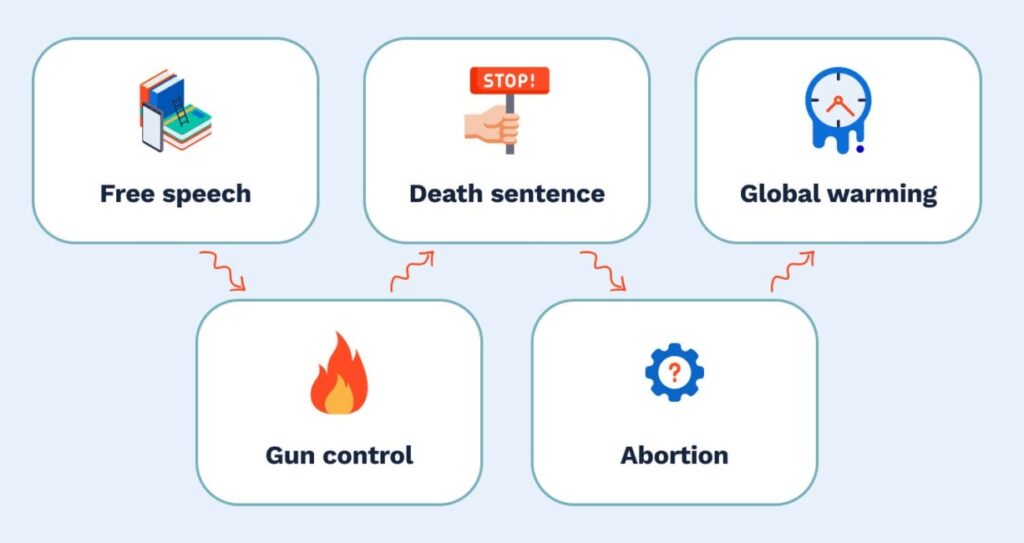
Philosophy has never advanced by consensus alone. From its earliest beginnings, it has been driven by disagreement, provocation, and the willingness to question what appears settled. Many of the ideas now regarded as foundational were once seen as dangerous, subversive, or deeply unsettling. This tradition explains why controversial debate topics continue to occupy a central place in philosophical reflection. They force assumptions into the open and expose the limits of habitual thinking.
In contemporary culture, controversy is often associated with outrage or polarization. Philosophy approaches it differently. A philosophical controversy is not defined by shock value but by the depth of the disagreement and the seriousness of the reasons on each side. When philosophers engage with controversial topics to write about, their aim is not to inflame but to understand what is really at stake beneath surface disputes.
This article examines several enduring areas of philosophical controversy. Rather than offering final answers, it explores why these issues remain contested and what their persistence reveals about human reason, values, and self understanding.
What Makes a Topic Philosophically Controversial
Not every disagreement qualifies as a philosophical controversy. A topic becomes controversial in philosophy when it touches fundamental concepts such as truth, reality, freedom, responsibility, or value. These are concepts that structure entire worldviews, so disagreement about them cannot be easily resolved by appealing to isolated facts.
Philosophical controversies also tend to resist definitive empirical resolution. Even when scientific data is relevant, interpretation depends on deeper assumptions. This is why some of the most controversial topics to talk about remain so despite centuries of discussion. They involve competing frameworks rather than simple errors.
Another defining feature is existential relevance. Many philosophical disputes matter because they shape how people live, judge, and relate to one another. The intensity of disagreement reflects the fact that something important is at stake, not merely an abstract puzzle.
Free Will and Determinism
Few issues illustrate philosophical controversy better than the debate over free will. The question is whether human beings genuinely choose their actions or whether every decision is determined by prior causes. This issue connects metaphysics, ethics, psychology, and law.
Determinists argue that every event, including human action, follows necessarily from preceding conditions. If this is true, then freedom may be an illusion. Others defend libertarian freedom, claiming that genuine choice requires the ability to act otherwise. Compatibilists attempt to reconcile freedom with determinism by redefining freedom in terms of acting according to one’s motives without external constraint.
Each position preserves something intuitively important while sacrificing something else. No resolution has succeeded in satisfying all philosophical and practical concerns.
Moral Relativism and Objective Values
Another enduring controversy concerns the status of moral values. Are moral norms objective truths or socially constructed conventions. Moral relativists emphasize cultural diversity and historical change, arguing that moral judgments depend on context. Moral realists maintain that some values hold regardless of belief or tradition.
This debate is controversial because it affects how disagreement itself is understood. If morality is relative, then moral criticism across cultures becomes problematic. If it is objective, then claims of tolerance may conflict with the assertion of moral truth.
Philosophy treats this issue not as a clash of opinions but as a dispute about the nature of normativity. The difficulty of grounding moral authority without appealing to either dogmatism or skepticism explains why this topic remains unresolved.
The Existence of God
Questions about God have been central to philosophy for centuries, and they remain among the most controversial topics to write about. Philosophical theology examines arguments for and against divine existence using reason rather than revelation.
Classical arguments include the cosmological argument, the ontological argument, and the argument from design. Critics challenge these arguments by questioning their premises or logical structure. The problem of evil presents another major difficulty, asking how suffering can be reconciled with an all powerful and benevolent deity.
What makes this topic persistently controversial is not only the diversity of arguments but also the existential weight of the conclusion. Belief or disbelief shapes one’s understanding of meaning, morality, and human destiny.
Personal Identity and the Self
The question of what makes a person the same over time is deceptively simple. Is identity grounded in memory, bodily continuity, psychological traits, or something else. Philosophers disagree sharply, making this one of the most interesting controversial topics.
Some theories emphasize psychological continuity, linking identity to memory and consciousness. Others focus on the body or the brain. Still others deny that personal identity is a deep fact at all, treating it as a practical convention.
This controversy matters because it affects responsibility, survival, and moral concern. Disagreements about identity influence debates on punishment, responsibility, and emerging technologies such as mind uploading.
Consciousness and the Mind Body Problem
The nature of consciousness remains one of the most controversial debate topics in contemporary philosophy. Materialists argue that mental states are nothing more than physical processes in the brain. Dualists maintain that consciousness cannot be reduced to matter.
Even among materialists, disagreement persists. Some endorse reductive explanations, while others accept that subjective experience poses a hard problem that resists current scientific accounts. This internal division highlights the depth of the issue.
Philosophy continues to grapple with consciousness because it sits at the intersection of subjective experience and objective explanation. The inability to fully bridge this gap explains why the problem remains unresolved.
Political Authority and Obligation
Political philosophy raises controversial questions about power and legitimacy. Why should individuals obey laws. What justifies political authority. Are states morally permissible or inherently coercive.
Some philosophers defend the state as a necessary framework for justice and cooperation. Others argue that political authority requires explicit consent, which rarely exists in practice. Anarchist critiques challenge the moral legitimacy of imposed authority altogether.
These disagreements remain controversial because they concern everyday social life. Unlike abstract metaphysical disputes, political controversies affect institutions, rights, and obligations directly.
Equality and Justice
Debates about equality are among the most controversial topics to talk about in modern philosophy. Should equality be understood in terms of opportunity, outcome, or respect. How should resources be distributed in a just society.
Egalitarian theories emphasize fairness and equal concern. Libertarian approaches stress individual rights and voluntary exchange. Other theories focus on capabilities or social recognition.
The controversy persists because different conceptions of equality reflect different views of human nature and social cooperation. No single framework commands universal acceptance.
Technology and Human Enhancement
Advances in technology have introduced new philosophical controversies. Should humans enhance their cognitive or physical capacities beyond natural limits. Does enhancement threaten human dignity or express human creativity.
Some philosophers warn that enhancement could undermine equality or authenticity. Others argue that resisting enhancement is arbitrary and that improving human capacities is a continuation of long standing practices.
These debates show how philosophy responds to changing conditions. They also illustrate how new technologies generate controversial topics to write about that combine ethical, metaphysical, and social concerns.
Funny Controversial Topics and the Role of Provocation
Not all controversy is solemn. Philosophy has long used humor, paradox, and exaggeration to provoke thought. Funny controversial topics such as paradoxes about time travel or identity swapping serve a serious purpose.
By presenting absurd scenarios, philosophers expose hidden assumptions. Humor lowers defenses and invites reflection without direct confrontation. This tradition shows that controversy need not always be hostile to be productive.
The effectiveness of such topics lies in their ability to reveal complexity beneath apparent simplicity.
Why Controversy Persists in Philosophy
The persistence of controversy does not indicate failure. It reflects the depth of the questions philosophy addresses. Many issues concern ultimate concepts that cannot be settled by observation alone.
Philosophy advances by refining questions, clarifying concepts, and revealing implications. Disagreement is part of this process. Each generation revisits old debates with new perspectives, keeping them alive.
This explains why lists of what are some controversial topics remain remarkably stable across centuries, even as contexts change.
The Value of Engaging With Controversial Topics
Engaging with controversial topics in philosophy cultivates intellectual humility and rigor. It requires understanding opposing views and recognizing the limits of one’s own assumptions.
Rather than seeking closure, philosophy values clarity. Controversial topics function as testing grounds for ideas, exposing strengths and weaknesses.
In this sense, controversy is not an obstacle but a resource. It keeps philosophical inquiry honest and dynamic.
Conclusion
Philosophical controversy is not a sign of disorder but of vitality. The most controversial topics endure because they touch the foundations of human thought and life. They resist simple resolution precisely because they matter.
By engaging seriously with controversial topics to talk about, philosophy fulfills its critical role. It challenges complacency, deepens understanding, and expands the space of reasoned disagreement.
In a world that often seeks quick answers, philosophy reminds us that some questions are worth arguing about indefinitely. The most interesting controversial topics continue to shape how humans understand themselves and the world they inhabit.