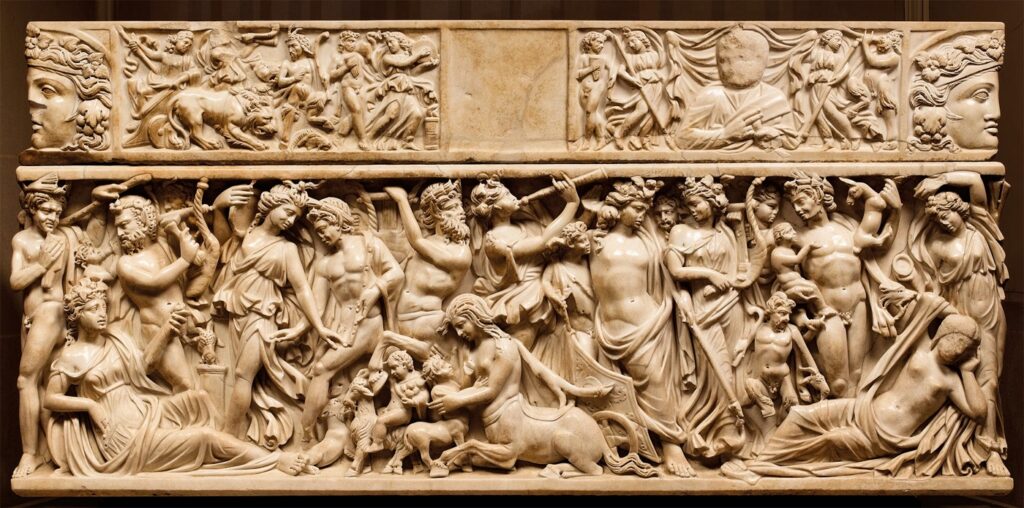
Ancient philosophy did not emerge suddenly as a purely rational discipline. It developed gradually within cultures that had long interpreted the world through mythology. In the ancient civilizations myths about gods, cosmic origins, divine justice, and the structure of the universe provided the earliest intellectual framework through which people understood reality. When philosophy appeared in ancient Greece and later spread across the Hellenistic and Roman worlds, it inherited this mythological background. Early philosophers did not simply abandon myth. Instead, they transformed its themes, questions, and symbolic structures into rational inquiry.
The relationship between mythology and philosophy is therefore one of intellectual continuity as well as transformation. Mythology supplied many of the questions that philosophy later attempted to answer through reason. It shaped the language, imagery, and conceptual assumptions within which philosophical thought developed. Understanding ancient philosophy requires recognizing how deeply it remained connected to mythological traditions.
Mythology as the Earliest Cosmology
In ancient societies, mythology functioned as the primary explanation of the universe. Myths were not merely stories meant for entertainment. They provided answers to fundamental questions about the origin of the world, the structure of nature, the authority of kings, and the moral order governing human life.
In Greek mythology, the cosmos emerged from primordial chaos. According to Hesiod’s Theogony, the first elements of existence included Chaos, Gaia (Earth), and Uranus (Sky). Through successive generations of divine beings, the world developed into an ordered system ruled by the Olympian gods. This narrative described not only the origins of the gods themselves but also the emergence of cosmic order from primordial disorder.
Similar cosmological myths existed throughout the ancient Near East. Babylonian mythology, preserved in the Enuma Elish, described the creation of the world through a cosmic struggle between divine forces. The god Marduk defeats the primordial chaos represented by Tiamat and establishes the ordered cosmos. These narratives portrayed the universe as the product of divine conflict and creative power.
Such myths provided a comprehensive worldview. They explained natural phenomena, legitimized political authority, and gave meaning to human existence. When philosophy emerged in the Greek world, it inherited many of the questions that mythology had attempted to answer.
From Divine Genealogy to Natural Principles
The earliest Greek philosophers began to reinterpret these cosmological questions in non mythological terms. Instead of describing the birth of gods, they sought to identify fundamental principles underlying the universe.
Thales of Miletus, often considered the first philosopher in the Greek tradition, proposed that water was the basic substance from which all things arise. Although his theory was simple, it represented a radical departure from mythological cosmology. Rather than attributing natural events to divine personalities, Thales attempted to explain them through a universal material principle.
Anaximander expanded this approach by introducing the concept of the apeiron, an indefinite and boundless origin from which all things emerge. Unlike the mythological narratives that described specific gods as creators, Anaximander proposed a more abstract principle governing the formation of the cosmos.
Anaximenes later suggested that air was the fundamental element underlying all reality. Through processes of condensation and rarefaction, air could transform into different forms of matter. These theories replaced mythological explanations with natural processes, yet they still addressed the same basic question that mythology had attempted to answer: how the universe came into being.
The shift from mythological narratives to natural principles marks one of the defining moments in the history of philosophy. However, the questions themselves remained deeply rooted in earlier mythological cosmology.
Mythological Themes in Pre-Socratic Thought
Even as early philosophers rejected literal mythological explanations, many continued to employ mythological imagery and symbolic language. The writings of Heraclitus illustrate this complex relationship between myth and philosophy.
Heraclitus described the universe as governed by a rational principle known as the logos. According to him, the cosmos is characterized by constant change and tension between opposing forces. He often used the metaphor of fire to describe the dynamic nature of reality.
Although Heraclitus rejected traditional mythological explanations, his language remained deeply poetic. His fragments resemble the style of ancient religious oracles, combining philosophical insight with symbolic imagery. In this sense, mythological expression persisted even as philosophy developed new methods of inquiry.
Another example appears in the philosophy of Empedocles. Empedocles proposed that the universe is composed of four fundamental elements: earth, air, fire, and water. These elements are governed by two cosmic forces, Love and Strife, which combine and separate them over time.
Although this theory presents a naturalistic explanation of cosmic change, the language of Love and Strife echoes mythological representations of divine forces. Empedocles himself even presented his philosophical ideas in poetic form, blending philosophical speculation with mythological symbolism.
Pythagorean Cosmology and Religious Tradition
The philosophical movement associated with Pythagoras demonstrates another way in which mythology influenced early philosophy. Pythagorean thinkers believed that the structure of the universe was fundamentally mathematical. They argued that numerical relationships governed the harmony of the cosmos.
At the same time, Pythagorean philosophy retained strong connections to religious traditions. Influenced by Orphic beliefs, the Pythagoreans taught that the human soul was immortal and could undergo cycles of rebirth. They believed that philosophical discipline could purify the soul and free it from the cycle of reincarnation.
The Orphic tradition itself originated in mythological narratives about the god Dionysus and the origins of humanity. According to Orphic myth, human beings contain both divine and earthly elements within their nature. This dual origin explains the tension between spiritual aspiration and material existence.
Pythagorean philosophy transformed these mythological ideas into a philosophical system that combined mathematics, ethics, and metaphysical speculation. Once again, mythology served as the background from which philosophical concepts developed.
Plato and the Philosophical Use of Myth
Plato provides one of the most sophisticated examples of how mythology influenced ancient philosophy. Although Plato emphasized rational argument, he frequently used mythological narratives to illustrate philosophical ideas.
One of the most famous examples is the Allegory of the Cave in The Republic. In this story, prisoners mistake shadows on a wall for reality until one of them escapes and discovers the true world outside the cave. Although presented as an allegory, the narrative functions similarly to myth. It uses imagery and storytelling to convey philosophical insights about knowledge and enlightenment.
Plato also used mythological narratives when discussing the soul and the afterlife. In the Myth of Er, he described how souls are judged after death and choose their future lives before returning to the world. This story addresses questions about moral responsibility and the consequences of human actions.
Plato did not treat these myths as literal accounts of reality. Instead, he used them as symbolic tools for exploring philosophical ideas that might be difficult to express through purely logical argument. Myth became a vehicle for philosophical imagination.
Aristotle and the Rationalization of Mythological Questions
Aristotle, Plato’s student, took a different approach. He placed greater emphasis on systematic reasoning and empirical observation. Nevertheless, Aristotle also inherited questions that had originated in mythological cosmology.
One of Aristotle’s central concerns was explaining motion and change in the universe. His concept of the “unmoved mover” represents a philosophical reinterpretation of earlier mythological ideas about divine causation. Instead of describing a god who actively shapes the world through direct intervention, Aristotle proposed a purely philosophical principle that explains why motion exists at all.
This concept demonstrates how philosophical reasoning gradually transformed mythological themes into abstract metaphysical principles. The divine figure of myth became the philosophical cause of motion and order.
Near Eastern Mythological Influences
Although Greek mythology played the most direct role in shaping Greek philosophy, the broader intellectual environment of the Mediterranean world also included influences from the Near East. Greek culture interacted extensively with Egyptian, Babylonian, and Phoenician civilizations.
Near Eastern myths about cosmic order, divine kingship, and the struggle between chaos and order influenced Greek cultural imagination. The idea that the universe emerged from a primordial state of disorder appears in both Greek and Mesopotamian cosmology.
These shared mythological themes contributed to a broader intellectual environment in which questions about cosmic origins and universal order were already well established before philosophy emerged.
Myth and the Formation of Philosophical Language
Mythology also influenced philosophy through language and metaphor. Many philosophical terms originated in poetic or religious contexts before acquiring technical meanings.
For example, the Greek concept of cosmos originally referred to order or arrangement and was used in mythological contexts to describe the structure of the universe. Philosophers later adopted the term to refer to the rationally ordered universe studied by natural philosophy.
Similarly, philosophical discussions of fate, justice, and necessity often drew upon earlier mythological concepts associated with divine authority and cosmic law.
The Transition from Mythos to Logos
The development of ancient philosophy is often described as a transition from mythos to logos. Mythos refers to narrative explanations rooted in tradition and storytelling, while logos refers to rational explanation based on argument and reasoning.
However, this transition was not an abrupt rejection of myth. Instead, it involved a gradual reinterpretation of mythological ideas. Philosophers retained many of the questions and symbolic frameworks inherited from myth while developing new methods for answering them.
Even after philosophy became more systematic, mythological imagery continued to influence philosophical thought. Plato’s myths and the symbolic language of early philosophers demonstrate that myth remained an important intellectual resource.
Conclusion
Ancient mythology played a fundamental role in shaping the origins of philosophy. Myths provided early explanations of cosmic origins, divine authority, and moral order. When philosophers began to question these explanations, they did not simply discard mythology. Instead, they transformed its themes into rational inquiry.
Greek philosophers such as Thales, Heraclitus, and Empedocles replaced divine narratives with natural principles while preserving mythological concerns about cosmic order and the origins of the universe. Plato later demonstrated how mythological storytelling could serve as a powerful tool for expressing philosophical ideas.
The relationship between mythology and philosophy therefore represents a transition rather than a complete break. Philosophy emerged from myth by seeking deeper and more systematic explanations of the same questions that myths had long attempted to answer. Through this transformation, ancient thinkers laid the intellectual foundations for the philosophical traditions that continue to shape Western thought today.