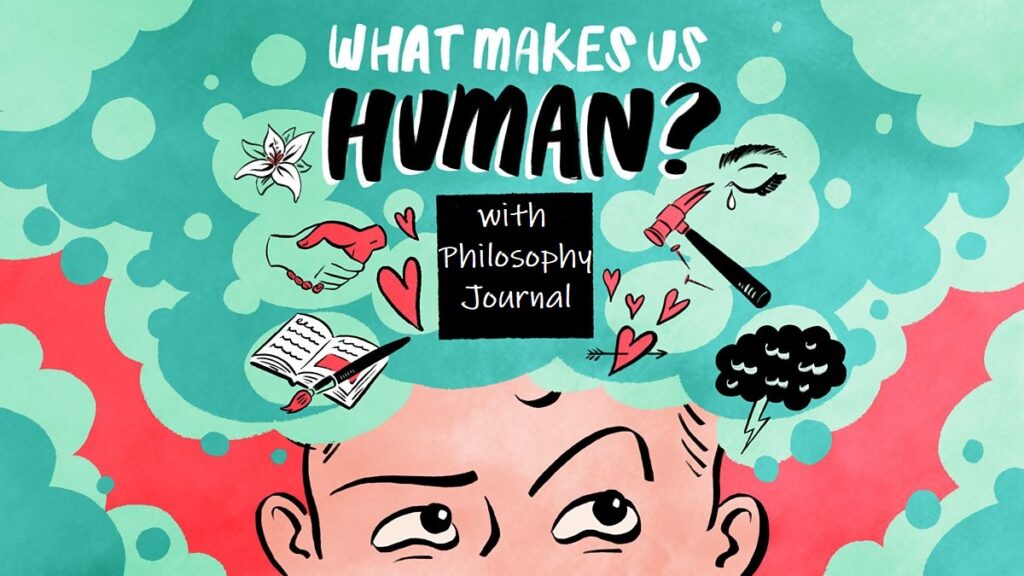
The question of what makes us human is one of the oldest and most persistent problems in philosophy. It is not a question that can be answered once and for all, because every attempt to define the human being reflects a particular perspective, a particular historical moment, and a particular set of assumptions about the world. Yet the question continues to return, because it lies at the center of all reflection about meaning, value, and existence.
To ask what makes us human is to ask what distinguishes us from other forms of life, but also what unites us with them. It is to ask whether humanity is defined by reason, by language, by consciousness, by morality, or by something deeper that resists simple categorization. It is also to ask whether being human is a fixed condition or an ongoing process.
This problem is not merely theoretical. It shapes how we understand ourselves, how we relate to others, and how we construct our societies. Every conception of the human being carries with it implications for ethics, politics, and culture. To explore what makes us human is therefore to explore the foundation of human life itself.
What Does It Mean to Be Human
To ask what it means to be human is not the same as asking for a list of characteristics. It is to inquire into a mode of existence. Being human is not simply a biological fact. It involves a way of experiencing the world, a way of interpreting reality, and a way of relating to oneself and others.
Human beings do not merely exist. They are aware of their existence. This awareness introduces a distance between the individual and the world. It allows reflection, questioning, and doubt. A human being can step back from immediate experience and ask what it means, whether it is true, and whether it should be otherwise.
This reflective capacity gives rise to freedom, but also to uncertainty. Unlike other forms of life that act according to instinct, humans must interpret their situation and choose how to respond. This creates a condition in which existence is not fully determined. It must be shaped through action and understanding.
To be human is therefore to live within this tension. It is to be both part of the world and capable of questioning it. It is to be situated within a given reality while also having the capacity to transform it.
Human Being Definition
Any attempt to define the human being faces an immediate difficulty. Definitions seek clarity and precision, but the human condition resists reduction to a single formula. Nevertheless, philosophical traditions have proposed various ways of understanding what a human being is.
One approach defines the human being as a rational animal. This emphasizes the capacity for reasoning, abstraction, and logical thought. According to this view, what distinguishes humans from other forms of life is their ability to think in terms of concepts, to form judgments, and to engage in systematic inquiry.
Another approach emphasizes language. Human beings do not merely communicate signals. They use complex systems of meaning that allow them to describe the world, express emotions, and construct shared realities. Language enables culture, tradition, and the transmission of knowledge across generations.
A third approach focuses on self consciousness. Humans are not only aware of the world but also aware of themselves as beings within it. This reflexive awareness allows for identity, memory, and the sense of a continuous self.
Each of these definitions captures an aspect of humanity, but none is sufficient on its own. Rationality without emotion, language without embodiment, or self consciousness without relation to the world would not fully describe what it means to be human.
Consciousness and the Inner World
One of the most distinctive features of human existence is the richness of inner experience. Human beings possess a capacity for reflection that extends beyond immediate perception. They can imagine possibilities, recall the past, and anticipate the future.
This inner world is not separate from reality. It shapes how reality is experienced. Perception is always interpreted, filtered through memory, expectation, and emotion. The human being does not encounter the world as a neutral observer but as an engaged participant.
The complexity of consciousness also introduces a sense of depth. There are layers of thought, feeling, and motivation that are not always fully accessible. This gives rise to introspection, but also to confusion. The human being can be opaque to itself.
This opacity is not a defect. It is part of what makes human existence dynamic. The self is not a fixed object but an ongoing process of interpretation and transformation.
Language and Meaning
Language plays a central role in shaping human life. It allows individuals to move beyond immediate experience and to engage with abstract ideas. Through language, humans create systems of meaning that organize their understanding of the world.
Meaning is not simply discovered. It is constructed. Words do not merely reflect reality. They participate in its formation. The way something is described influences how it is perceived and understood.
This does not mean that reality is arbitrary, but it does mean that human access to reality is mediated. Language creates a shared space in which individuals can communicate, but it also introduces the possibility of misunderstanding and ambiguity.
The human being is therefore a being of interpretation. It lives within networks of meaning that are constantly being negotiated and revised.
Freedom and Responsibility
One of the defining aspects of human existence is the capacity for choice. Human beings are not entirely determined by instinct or environment. They can reflect on their situation and decide how to act.
This capacity for choice introduces the idea of freedom. However, freedom is not simply the absence of constraint. It is the ability to take responsibility for one’s actions. To be free is to recognize that one’s decisions have consequences and to accept those consequences.
Freedom also involves uncertainty. There is no guarantee that a particular choice will lead to a desired outcome. The human being must act without complete knowledge, navigating a world that is complex and often unpredictable.
This condition can be experienced as both empowering and burdensome. It allows for creativity and transformation, but it also creates anxiety and doubt.
The Experience of Time
Human existence is deeply shaped by the experience of time. Unlike other forms of life that may be primarily oriented toward the present, humans are aware of past and future.
Memory allows individuals to construct a narrative of their lives. This narrative provides continuity and identity, linking past experiences to present actions. At the same time, anticipation of the future influences decisions and behavior.
The awareness of time also introduces finitude. Human beings know that their lives are limited. This knowledge affects how they understand meaning and value. It raises questions about purpose, legacy, and the significance of individual actions.
Time is therefore not merely a neutral dimension. It is an essential aspect of human existence, shaping how life is experienced and understood.
Social Existence and Recognition
Human beings do not exist in isolation. They are fundamentally social. From the earliest stages of life, individuals depend on others for survival, learning, and development.
Social interaction is not only practical. It is also constitutive of identity. Individuals come to understand themselves through their relationships with others. Recognition by others plays a crucial role in shaping self awareness.
This social dimension introduces both connection and conflict. Cooperation allows for the development of complex societies, but differences in perspective and interest can lead to tension.
The human being must navigate these relationships, balancing individuality and belonging. This balance is never fixed. It must be continually negotiated.
Emotion and Value
Emotion is an integral part of human existence. It is not opposed to reason but intertwined with it. Emotions influence perception, decision making, and interpretation.
Through emotion, the world acquires significance. Things are not merely present. They matter. This sense of value is what gives direction to human action.
Different individuals may experience and interpret emotions in different ways, but the presence of emotion is universal. It connects human beings to their environment and to each other.
Understanding what makes us human therefore requires acknowledging the role of emotion in shaping experience and behavior.
Creativity and Transformation
Human beings possess a remarkable capacity for creativity. They can produce art, develop technologies, and imagine new forms of life.
Creativity is not limited to exceptional individuals. It is present in everyday activities, in problem solving, in communication, and in the reinterpretation of experience.
This capacity allows humans to transform their environment and themselves. It also introduces the possibility of change on a scale that is unique among living beings.
Creativity reflects the openness of human existence. The future is not predetermined. It can be shaped through action and imagination.
The Search for Meaning
Perhaps the most distinctive feature of human existence is the search for meaning. Human beings do not simply live. They ask why they live. They seek to understand the significance of their actions and experiences.
This search takes many forms. It may involve religion, philosophy, art, or personal reflection. It may lead to shared systems of belief or to individual interpretations.
Meaning is not given in a simple way. It must be constructed and maintained. This process can be difficult and uncertain, but it is central to human life.
The absence of meaning can lead to a sense of emptiness, while the presence of meaning can provide direction and purpose.
Conclusion
What makes us human cannot be reduced to a single trait or definition. It is a complex interplay of consciousness, language, freedom, sociality, emotion, and creativity.
To be human is to exist within a world that is both given and interpreted, to be capable of reflection and action, and to engage in an ongoing search for meaning.
This condition is not static. It evolves with individuals and societies. It is shaped by history, culture, and personal experience.
The question of what makes us human therefore remains open. It invites continuous exploration, reminding us that understanding humanity is itself a part of being human.