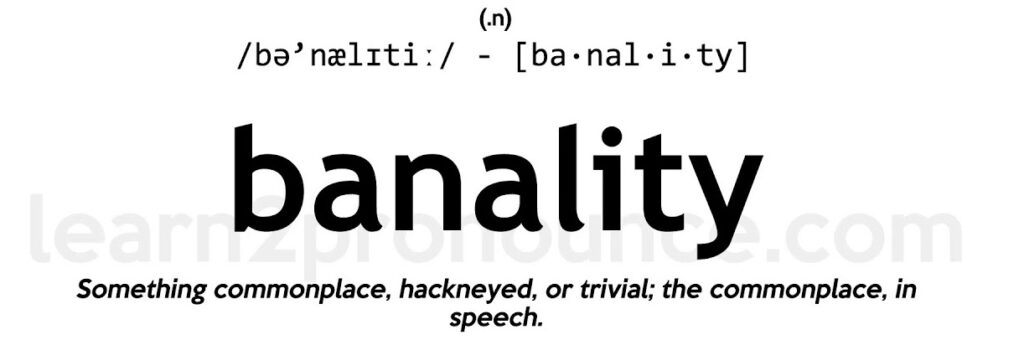
The word banal is often used casually, as a dismissive label for something that appears unoriginal, predictable, or lacking in depth. Yet behind this seemingly simple term lies a complex philosophical problem. To call something banal is not merely to describe it. It is to make a judgment about value, meaning, and the conditions under which something appears significant or insignificant.
Banality touches on questions about repetition, familiarity, and the erosion of meaning. It raises the issue of whether something becomes empty through overuse, or whether it reveals something essential about the structure of human experience. The banal is not simply the trivial. It is the ordinary seen in a diminished light.
To explore banality philosophically is therefore to examine how meaning is formed, how it fades, and how it might be recovered.
What Does Banal Mean
At the most basic level, banal refers to something that is commonplace to the point of losing interest or originality. A phrase that has been repeated too often, an idea that no longer provokes thought, or an image that fails to engage the imagination may all be described as banal.
However, this definition does not fully capture the depth of the concept. The banal is not merely what is common. Many common things retain significance. Language itself is composed of common words, yet it can produce profound meaning. The difference lies in how something is experienced.
Banality emerges when familiarity becomes empty, when repetition no longer deepens understanding but instead flattens it. It is a condition in which something that could be meaningful is perceived as devoid of significance.
This perception depends on context. What appears banal in one situation may appear meaningful in another. The same phrase, repeated in a different setting, can regain its force. Banality is therefore not an inherent property of objects or ideas. It is a relation between the observer and what is observed.
Repetition and the Erosion of Meaning
One of the central features of banality is repetition. When something is repeated, it can either reinforce meaning or diminish it. Repetition can deepen understanding, as in the case of ritual or practice. It can also lead to desensitization, where the repeated element loses its impact.
The banal arises when repetition no longer contributes to meaning. Instead of revealing new aspects, it produces a sense of exhaustion. The individual no longer engages with what is repeated. It becomes background noise.
This process is evident in everyday language. Expressions that were once vivid can become clichés. They are still used, but they no longer evoke the same response. Their meaning becomes thin, almost automatic.
This does not mean that repetition is inherently negative. It means that repetition without renewal leads to banality. The challenge is to sustain meaning within repetition.
Banality and Perception
Banality is closely linked to perception. It depends on how something is seen or experienced. An object or idea is not banal in itself. It becomes banal when it is perceived as lacking significance.
This raises the question of whether banality reflects the object or the observer. In some cases, the source lies in the object, in a lack of originality or depth. In others, it lies in the observer, in a failure to engage.
The possibility that banality is perceptual suggests that it can be transformed. What appears banal can be reinterpreted and rediscovered.
The Ordinary and the Banal
The relationship between the ordinary and the banal is complex. The ordinary refers to what is common and familiar. The banal is a particular way of experiencing the ordinary, one that strips it of interest.
Not all ordinary things are banal. The ordinary can be rich with meaning. Everyday experiences can reveal deep truths.
The banal arises when the ordinary is no longer attended to. It is when familiarity leads to indifference rather than understanding.
Banality and Modern Life
Modern life is often associated with banality. The repetition of routines, the standardization of products, and the saturation of media can create a sense of uniformity.
In such conditions, experiences can begin to feel interchangeable. The same patterns repeat across different contexts, reducing the sense of uniqueness.
This environment can encourage banality. However, this does not mean that modern life is inherently banal. It means that its conditions make such perception more likely.
Language and the Banal
Language plays a central role in banality. Words and phrases can become banal when they are overused or used without reflection.
This is particularly evident in public discourse, where certain expressions are repeated to the point of losing their impact. They become formulas rather than meaningful statements.
The banal use of language can obscure thought. It can replace genuine understanding with automatic repetition.
Banality and Ethics
Banality also has an ethical dimension. When actions or ideas become banal, they may no longer be critically examined. This can lead to a form of moral indifference.
The repetition of certain practices can make them appear natural or inevitable. Individuals may follow them without reflection.
The ethical problem of banality lies in the possibility that significant actions can be performed without awareness.
Creativity as a Response to Banality
One way to respond to banality is through creativity. Creativity introduces new perspectives and reinterprets the familiar.
By engaging creatively with the ordinary, individuals can restore meaning. They can transform what appears banal into something significant.
The Possibility of Rediscovery
Banality does not mean that meaning is lost permanently. What appears banal can be rediscovered.
Rediscovery involves a shift in perception. It requires attention and reflection.
Through rediscovery, the ordinary can regain its depth. The banal can be overcome by renewed engagement.
Banality and Experience in Everyday Life
The experience of banality often unfolds in subtle ways. It is not always recognized immediately. It can emerge gradually, through the slow accumulation of repetition and familiarity. What was once engaging becomes routine, and what was once meaningful becomes background.
This is especially visible in daily habits. Activities that are repeated without reflection can lose their sense of purpose. The individual continues to act, but the connection between action and meaning weakens. The experience becomes mechanical.
Yet this does not mean that the activity itself has changed. The transformation occurs in the way it is experienced. The same action can be either meaningful or empty depending on the presence or absence of attention.
This suggests that the problem is not located solely in the external world. It is also rooted in the structure of experience. Banality arises when engagement is replaced by automatic repetition.
Attention and the Recovery of Meaning
If banality is linked to a loss of engagement, then attention becomes central to its overcoming. Attention is not simply awareness. It is an active orientation toward what is present. It involves a willingness to see, to question, and to remain open.
When attention is restored, the familiar can appear differently. What seemed empty can reveal new aspects. This does not require changing the object itself. It requires changing the mode of perception.
This insight has implications beyond philosophy. It suggests that meaning is not fixed but dynamic. It can diminish or expand depending on how the world is approached.
The recovery of meaning is therefore not a return to something lost in a literal sense. It is a transformation in how the present is experienced.
Banality and the Passage of Time
Time plays an important role in the emergence of banality. Repetition unfolds over time, and familiarity accumulates through it. What is new gradually becomes known, and what is known can become unnoticed.
This process is not inherently negative. It allows for stability and continuity. Without repetition, there would be no learning or habit. However, when repetition is not accompanied by reflection, it can lead to a flattening of experience.
The passage of time can therefore both support and undermine meaning. It creates the conditions for depth, but also for indifference.
The challenge is to maintain a relationship to time that preserves awareness. This involves recognizing that familiarity does not have to lead to emptiness. It can also lead to understanding.
Social Dimensions of Banality
Banality is not only an individual experience. It also has a social dimension. Shared practices, norms, and forms of communication can become routine to the point of losing their significance.
In social contexts, repetition can create stability, but it can also produce conformity. Individuals may adopt patterns of thought and behavior without questioning them. What is repeated becomes accepted.
This can lead to a form of collective indifference. When everyone participates in the same patterns without reflection, the possibility of critical engagement diminishes.
At the same time, social interaction also provides opportunities for renewal. Dialogue, disagreement, and reinterpretation can challenge routine and restore meaning.
Banality and Technology
In contemporary life, technology plays a significant role in shaping experience. Digital environments are characterized by rapid repetition, constant exposure, and continuous streams of information.
These conditions can intensify the experience of banality. Content is consumed quickly and replaced just as quickly. The constant flow reduces the time available for reflection.
As a result, experiences can become interchangeable. Distinction is difficult to maintain when everything is presented in the same format and at the same pace.
However, technology also offers possibilities for engagement. It can provide access to knowledge, facilitate communication, and support creative expression.
The effect of technology on banality therefore depends on how it is used. It can either reinforce repetition without reflection or create opportunities for renewed attention.
The Role of Philosophy
Philosophy can be understood as a response to banality. It seeks to question what is taken for granted, to examine what appears obvious, and to restore depth to what has become routine.
By analyzing concepts, clarifying language, and exploring assumptions, philosophy interrupts automatic patterns of thought. It encourages a different mode of engagement, one that resists indifference.
This does not eliminate banality, but it provides tools for addressing it. It opens the possibility of seeing the familiar in a new way.
Philosophy therefore does not stand outside everyday life. It operates within it, transforming how it is understood.
Banality and the Limits of Novelty
One possible response to banality is the search for constant novelty. If repetition leads to emptiness, then new experiences may seem like a solution.
However, this approach has its limits. Novelty can quickly become repetition in another form. What is new today becomes familiar tomorrow.
This suggests that the problem cannot be solved simply by replacing the familiar with the new. The underlying issue lies in the mode of engagement, not only in the object of experience.
Meaning does not depend solely on novelty. It depends on the depth of attention and interpretation.
Conclusion
Banality is more than a description of triviality. It is a condition that arises from the interaction between repetition, perception, and meaning.
To understand what banal means is to explore how familiarity can lead either to indifference or to insight. It is to recognize that the loss of meaning depends on how the world is experienced.
Banality reveals both a limitation and a possibility. It shows how meaning can fade, but also how it can be restored through attention, reflection, and engagement.
In this sense, banality is not merely something to avoid. It is a phenomenon that invites deeper awareness of how experience is shaped and how meaning is sustained.