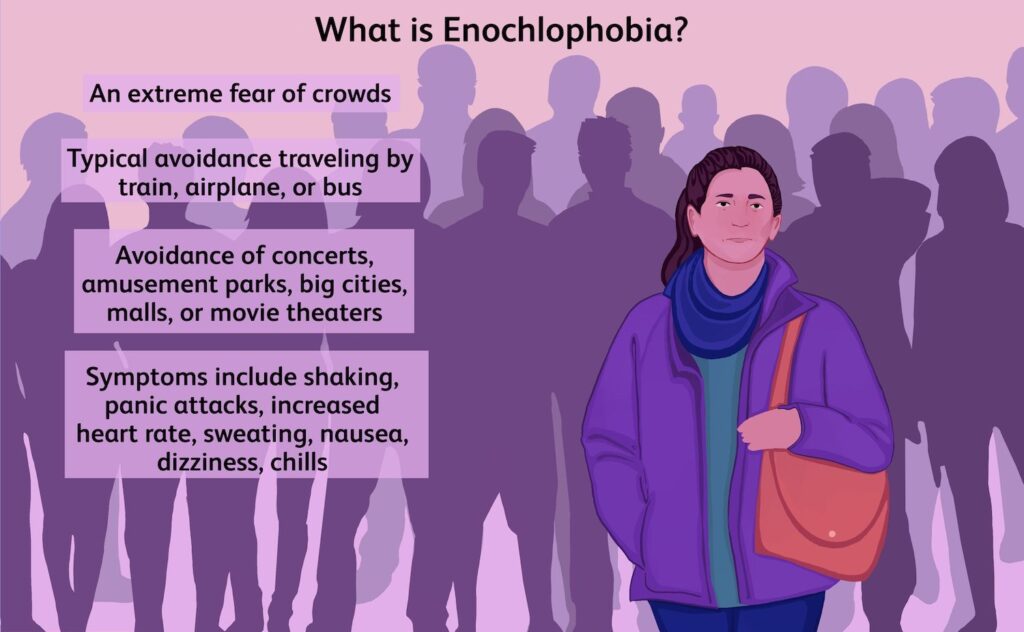
Enochlophobia, commonly understood as the fear of crowds, is often treated as a psychological condition. It is described in clinical terms as a form of anxiety that arises in situations where the individual is surrounded by large numbers of people. Yet this description, while useful, does not exhaust the meaning of the phenomenon. The fear of crowds is not only a psychological reaction. It can also be approached as a philosophical problem, one that reveals deeper tensions between individuality and collectivity, autonomy and dissolution, self and mass.
To examine enochlophobia philosophically is to ask what exactly is feared in the presence of the crowd. Is it merely physical proximity, the possibility of harm, or something more subtle and existential? The crowd is not simply a group of individuals. It is a transformation of social reality, a condition in which distinctions blur and the individual risks being absorbed into a larger, impersonal whole.
The Crowd as a Loss of Individuality
One of the most immediate philosophical interpretations of enochlophobia concerns the fear of losing individuality. In everyday life, individuals maintain a sense of separateness. They occupy distinct positions, make independent choices, and sustain personal identities. The crowd disrupts this structure.
In a dense crowd, the boundaries between individuals become less clear. Movement is constrained, personal space disappears, and actions are influenced by the behavior of others. The individual is no longer fully autonomous. Instead, they become part of a collective flow.
This experience can be unsettling because it challenges the sense of self as a stable and independent entity. The fear is not only of physical discomfort but of a deeper dissolution. The individual confronts the possibility that their identity is not as solid as it appears, that it can be altered or even erased under certain conditions.
Autonomy and the Threat of the Collective
Closely related to the fear of losing individuality is the fear of losing autonomy. Autonomy is the capacity to act according to one’s own decisions. It is a central value in many philosophical traditions, associated with freedom and responsibility.
The crowd introduces a different dynamic. Decisions are no longer entirely individual. They are influenced by the movement, emotions, and actions of others. In extreme cases, the individual may feel carried along by the crowd, unable to resist its direction.
This loss of control can produce anxiety. It reveals the fragility of autonomy, showing that it depends on conditions that are not always present. The individual is not always the master of their actions. Under certain circumstances, they become subject to forces that exceed their control.
Enochlophobia can therefore be understood as a response to this realization. It is a reaction to the possibility that autonomy is not absolute but contingent.
The Crowd and the Experience of Anonymity
Another dimension of enochlophobia concerns anonymity. In a crowd, individuals are often unrecognizable. They become part of an undifferentiated mass. This anonymity can have ambiguous effects.
On one hand, anonymity can be liberating. It allows individuals to act without being identified, to escape social expectations and constraints. On the other hand, it can be threatening. Without recognition, the individual loses the confirmation of their identity that comes from others.
Recognition plays a crucial role in human life. It is through interaction with others that individuals come to understand themselves. In a crowd, this process is disrupted. The individual is seen but not recognized, present but not acknowledged as a distinct person.
The fear associated with enochlophobia may arise from this lack of recognition. It is the fear of becoming invisible within the visible, of existing without being truly seen.
The Crowd as a Site of Unpredictability
Crowds are inherently unpredictable. Unlike small groups, where interactions can be more easily understood and anticipated, large crowds generate complex dynamics. Emotions can spread rapidly, behavior can change suddenly, and situations can escalate without warning.
This unpredictability creates a sense of uncertainty. The individual cannot fully anticipate what will happen next. They must navigate a situation that is constantly shifting.
Philosophically, this unpredictability reflects the limits of rational control. It shows that human behavior is not always governed by stable rules or predictable patterns. The crowd becomes a manifestation of contingency, a reminder that not everything can be understood or controlled.
The fear of crowds can thus be interpreted as a fear of uncertainty itself. It is the discomfort that arises when familiar structures of order and predictability break down.
Embodiment and Physical Vulnerability
Enochlophobia also has a bodily dimension. In a crowd, the body is exposed to proximity, pressure, and potential harm. Personal space is reduced, and the ability to move freely is constrained.
This physical vulnerability can trigger fear. The individual becomes aware of their dependence on the behavior of others. Safety is no longer entirely within their control.
From a philosophical perspective, this experience highlights the embodied nature of human existence. The self is not an abstract entity but a being situated in a physical world, subject to forces that can affect it.
The crowd intensifies this awareness. It makes the individual conscious of their fragility, of the fact that their well being depends on conditions that are not entirely stable.
The Crowd and the Dissolution of Responsibility
In addition to its effects on individuality and autonomy, the crowd also influences the sense of responsibility. In a large group, actions are often diffused across many individuals. It becomes difficult to assign responsibility to any one person.
This diffusion can lead to behaviors that would not occur in smaller settings. Individuals may act in ways that they would otherwise avoid, because the sense of personal accountability is reduced.
The fear associated with enochlophobia may include a concern about this moral dimension. The crowd is not only a physical environment but a social condition in which ethical norms can become unstable.
This instability challenges the idea of the individual as a responsible agent. It raises questions about how responsibility is maintained in collective contexts.
Isolation and the Preference for Distance
The fear of crowds often leads to a preference for solitude or small group interactions. This preference can be understood as an attempt to preserve individuality, autonomy, and control.
Isolation provides a space in which the individual can maintain clear boundaries and make decisions without external pressure. It offers a sense of stability and predictability that is lacking in crowded environments.
However, this preference also introduces a tension. Human beings are social by nature. Complete isolation is neither possible nor desirable for most individuals. The challenge is to find a balance between engagement with others and the preservation of individuality.
Enochlophobia highlights this tension. It reveals the difficulty of navigating the space between solitude and collectivity.
The Crowd in Modern Society
In modern societies, crowds are a common feature of urban life. Public transportation, events, and public spaces bring large numbers of people together.
This context amplifies the relevance of enochlophobia. The fear of crowds is not limited to exceptional situations. It can arise in everyday environments.
At the same time, modern society often values connectivity and interaction. Crowds are associated with social life, cultural events, and economic activity.
This creates a contradiction. The crowd is both necessary and potentially threatening. It is a space of opportunity and a source of anxiety.
Toward a Philosophical Understanding
To understand enochlophobia philosophically is not to reduce it to a simple explanation. It is to recognize that the fear of crowds reflects deeper aspects of human existence.
It reveals the fragility of individuality, the contingency of autonomy, the importance of recognition, and the limits of control. It also highlights the embodied and social nature of human life.
The crowd is not merely an external condition. It is a situation in which fundamental features of existence become visible. The fear it produces is therefore not only a reaction to immediate circumstances but a response to underlying existential tensions.
Conclusion
Enochlophobia, when examined philosophically, emerges as more than a clinical condition. It is a window into the complexities of human existence.
The fear of crowds reflects concerns about identity, autonomy, recognition, and vulnerability. It reveals the challenges of living in a world that is both social and unpredictable.
Understanding this fear requires attention not only to psychological factors but also to the broader context in which human life unfolds. It invites reflection on what it means to be an individual within a collective, to maintain a sense of self in the presence of others, and to navigate the tension between isolation and participation.
In this sense, enochlophobia is not merely a problem to be solved. It is a phenomenon that can deepen our understanding of the human condition.