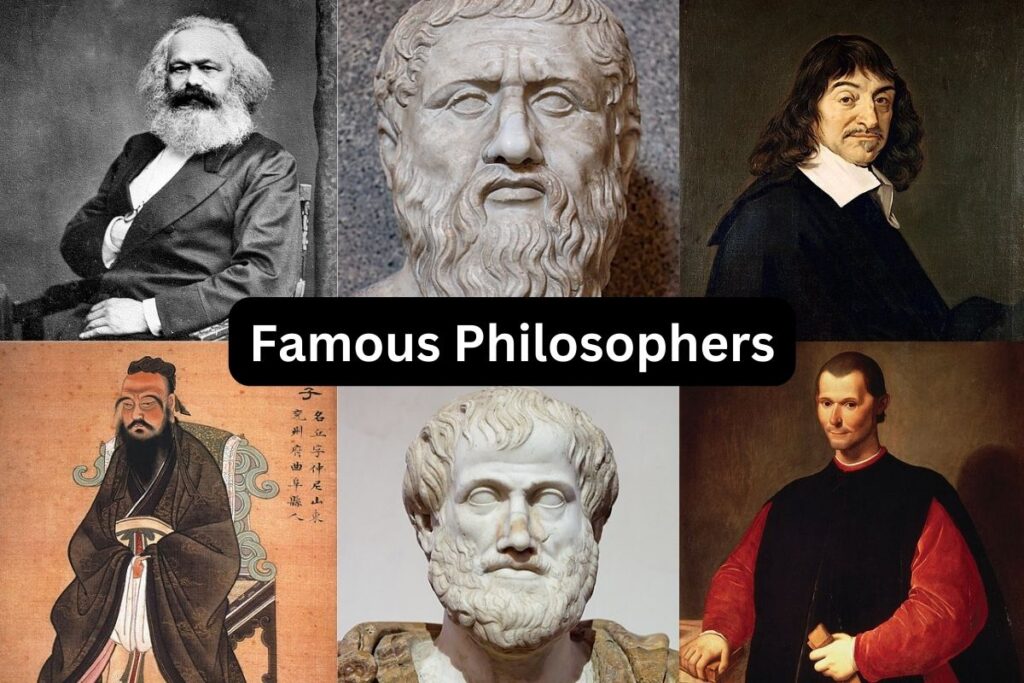
Famous philosophers occupy a unique place in intellectual history. Their fame does not arise from popularity, spectacle, or personal charisma, but from the lasting power of their ideas. A philosopher becomes famous when later generations are unable to think seriously about certain problems without encountering that thinker’s concepts, questions, or methods. Fame in philosophy is therefore not immediate and rarely proportional to public recognition during a philosopher’s lifetime. It is retrospective, cumulative, and grounded in influence.
Philosophers become famous in different ways. Some introduce entirely new questions that redefine what philosophy is about. Others offer systematic answers that dominate thought for centuries. Some are remembered for founding traditions, others for dismantling them. In all cases, philosophical fame is measured by endurance. A philosopher remains famous because their work continues to structure debate, whether through agreement, criticism, or reinterpretation.
Because philosophy develops historically, famous philosophers cannot be understood outside of time. Ideas emerge in response to specific intellectual, political, and cultural conditions. A philosopher writing in antiquity faces different problems than one writing in the modern world, and both differ from those faced today. For this reason, the most basic principle for organizing philosophers correctly is chronology. Philosophy is not a collection of isolated insights. It is a sequence of arguments, reactions, and transformations unfolding over time.
Listing famous philosophers chronologically, from earliest to latest, is therefore the most accurate and intellectually honest approach. This method reflects how philosophical influence actually works. Later thinkers respond to earlier ones, not the other way around. Chronology allows the reader to see how concepts evolve, how problems persist or change, and how entire traditions form and dissolve. It prevents the false impression that all philosophers are engaged in the same conversation under identical conditions.
Another sound approach is to group philosophers by historical period. Philosophy is commonly divided into broad eras such as ancient, medieval, early modern, modern, and contemporary. These divisions are not arbitrary. They correspond to major shifts in how philosophy understands reason, truth, authority, and the human being. Within each period, philosophers should again be ordered chronologically. This preserves both historical context and intellectual continuity.
Problems arise when philosophers are listed without regard to time. Mixing figures from different centuries as if they were contemporaries obscures the logic of philosophical development. It encourages anachronism, where earlier thinkers are judged by standards that did not yet exist, or later thinkers are treated as refinements of ideas they never encountered. Proper ordering guards against this distortion.
Ranking philosophers by fame is more delicate, but not impossible. If philosophers are ranked, the criteria must be clear. Fame in philosophy is best measured by long term influence across generations, disciplines, and cultures. This includes how often a philosopher is engaged by later thinkers, how foundational their concepts are, and how central they remain to education and scholarship. Such rankings are always approximate and should never be treated as objective truth. Philosophical importance cannot be calculated with precision.
It is also essential to distinguish fame from approval. A philosopher may be famous because their ideas were controversial, disruptive, or widely rejected. Influence does not require agreement. Some philosophers shape history precisely by forcing others to define themselves in opposition. Fame reflects impact, not correctness.
Another common mistake in listing philosophers is confusing philosophical fame with cultural visibility. Some philosophers are well known outside academic contexts, while others are central within philosophy but largely unknown to the general public. A proper list prioritizes philosophical significance over media presence or contemporary relevance. Philosophy operates on long time scales, and its canon is shaped slowly.
Selectivity is crucial. Not every philosopher belongs on a list of famous philosophers. Expanding lists indiscriminately weakens their meaning. A famous philosopher is one whose work remains structurally important, not merely historically interesting. Clear criteria preserve the integrity of the category.
When philosophers are listed properly, the list itself becomes instructive. It shows how philosophy moves from foundational questions to refined distinctions, from metaphysical systems to critiques of those systems, from confidence in reason to awareness of its limits. A well ordered list does not merely name thinkers. It reveals the architecture of philosophical history.
Famous philosophers should therefore be presented with respect for time, influence, and intellectual context. Chronology should guide the structure. Periodization should provide orientation. Rankings, if used, should be cautious and justified. When these principles are followed, a list of famous philosophers becomes more than a reference tool. It becomes a map of how human thought has struggled, advanced, corrected itself, and continued across centuries.
List of 100 Most Famous Philosophers
- Aristotle (384–322 BCE) – Greece
Systematized logic, metaphysics, ethics, politics, and natural science. - Plato (c. 428–348 BCE) – Greece
Founded Western metaphysics and political philosophy through dialogues. - Socrates (c. 470–399 BCE) – Greece
Established philosophy as ethical inquiry through dialectical questioning. - Immanuel Kant (1724–1804) – Germany
Reframed knowledge, morality, and reason through critical philosophy. - René Descartes (1596–1650) – France
Founded modern philosophy and rationalism with methodical doubt. - Friedrich Nietzsche (1844–1900) – Germany
Critiqued morality, religion, and truth; reshaped modern thought. - John Locke (1632–1704) – England
Founded empiricism and modern political liberalism. - Karl Marx (1818–1883) – Germany
Developed materialist theory of history and critique of capitalism. - Confucius (551–479 BCE) – China
Shaped East Asian ethics, politics, and social philosophy. - David Hume (1711–1776) – Scotland
Advanced empiricism and skepticism about causation and self. - Thomas Aquinas (1225–1274) – Italy
Synthesized Aristotelian philosophy with Christian theology. - Jean-Jacques Rousseau (1712–1778) – France
Influenced modern political theory and ideas of freedom. - G. W. F. Hegel (1770–1831) – Germany
Developed dialectical philosophy of history and spirit. - Thomas Hobbes (1588–1679) – England
Founded modern political realism and social contract theory. - Baruch Spinoza (1632–1677) – Netherlands
Developed rationalist metaphysics and ethical naturalism. - Augustine of Hippo (354–430) – Roman Africa
Shaped Christian philosophy and theology. - Arthur Schopenhauer (1788–1860) – Germany
Developed pessimistic metaphysics centered on will. - Jean-Paul Sartre (1905–1980) – France
Leading figure of existentialism and radical freedom. - Simone de Beauvoir (1908–1986) – France
Developed existentialist ethics and feminist philosophy. - Ludwig Wittgenstein (1889–1951) – Austria
Revolutionized philosophy of language and meaning. - Epictetus (c. 50–135) – Roman Empire
Taught Stoic ethics focused on inner freedom. - Marcus Aurelius (121–180) – Roman Empire
Expressed Stoicism as personal moral discipline. - Seneca (c. 4 BCE–65 CE) – Roman Empire
Applied Stoicism to ethics, politics, and psychology. - Michel Foucault (1926–1984) – France
Analyzed power, knowledge, and social institutions. - Martin Heidegger (1889–1976) – Germany
Reoriented philosophy around being and existence. - Bertrand Russell (1872–1970) – United Kingdom
Advanced logic, analytic philosophy, and social critique. - John Stuart Mill (1806–1873) – United Kingdom
Developed liberal utilitarian ethics and political theory. - Blaise Pascal (1623–1662) – France
Explored reason, faith, and human limitation. - Al-Farabi (c. 872–950) – Abbasid Caliphate
Translated Greek philosophy into Arabic. - Averroes (1126–1198) – Al-Andalus
Preserved and interpreted Aristotle for the West. - John Rawls (1921–2002) – United States
Founded modern political liberalism and justice theory. - Hannah Arendt (1906–1975) – Germany / USA
Analyzed totalitarianism and political responsibility. - Voltaire (1694–1778) – France
Promoted Enlightenment critique of religion and authority. - Montesquieu (1689–1755) – France
Developed separation of powers theory. - Jeremy Bentham (1748–1832) – England
Founded utilitarian ethics. - William James (1842–1910) – United States
Developed pragmatism and philosophy of mind. - Søren Kierkegaard (1813–1855) – Denmark
Founded existential philosophy of subjectivity. - Avicenna (980–1037) – Persia
Systematized metaphysics and medicine. - Giordano Bruno (1548–1600) – Italy
Defended infinite cosmos and philosophical freedom. - Plotinus (204–270) – Roman Empire
Founded Neoplatonism. - Zeno of Citium (c. 334–262 BCE) – Greece
Founded Stoic philosophy. - Francis Bacon (1561–1626) – England
Promoted empirical scientific method. - Edmund Husserl (1859–1938) – Germany
Founded phenomenology. - Thomas Kuhn (1922–1996) – United States
Introduced paradigm shifts in science philosophy. - Jacques Derrida (1930–2004) – France
Founded deconstruction. - Heraclitus (c. 535–475 BCE) – Greece
Emphasized flux and becoming. - Parmenides (c. 515–450 BCE) – Greece
Introduced ontology of being. - Protagoras (c. 490–420 BCE) – Greece
Advanced relativism and rhetoric. - Democritus (c. 460–370 BCE) – Greece
Developed atomic theory. - Anaxagoras (c. 500–428 BCE) – Greece
Introduced mind as ordering principle. - Anaximander (c. 610–546 BCE) – Greece
Developed early cosmology. - Anaximenes (c. 586–526 BCE) – Greece
Proposed air as primary substance. - Thales (c. 624–546 BCE) – Greece
First natural philosopher. - Pythagoras (c. 570–495 BCE) – Greece
Linked mathematics and metaphysics. - Diogenes of Sinope (c. 412–323 BCE) – Greece
Radical ethical minimalism. - Epicurus (341–270 BCE) – Greece
Developed atomistic ethics of tranquility. - Boethius (c. 477–524) – Roman Italy
Bridged ancient and medieval philosophy. - Roger Bacon (1214–1292) – England
Early advocate of experimental science. - Duns Scotus (1266–1308) – Scotland
Developed subtle metaphysics and theology. - William of Ockham (1287–1347) – England
Advanced nominalism and methodological simplicity. - Francisco Suárez (1548–1617) – Spain
Influenced modern metaphysics and law. - Giambattista Vico (1668–1744) – Italy
Founded philosophy of history. - Étienne Bonnot de Condillac (1714–1780) – France
Developed sensationist empiricism. - Johann Gottfried Herder (1744–1803) – Germany
Influenced cultural and historical philosophy. - Friedrich Schelling (1775–1854) – Germany
Developed nature philosophy. - Auguste Comte (1798–1857) – France
Founded positivism and sociology. - Herbert Spencer (1820–1903) – England
Applied evolutionary theory to society. - George Santayana (1863–1952) – Spain / USA
Blended materialism with cultural critique. - Henri Bergson (1859–1941) – France
Developed philosophy of time and intuition. - Alfred North Whitehead (1861–1947) – UK
Founded process philosophy. - Karl Popper (1902–1994) – Austria / UK
Developed falsificationism. - Isaiah Berlin (1909–1997) – UK
Developed value pluralism. - Gilbert Ryle (1900–1976) – UK
Critiqued Cartesian dualism. - Paul Ricoeur (1913–2005) – France
Developed hermeneutics and narrative identity. - Herbert Marcuse (1898–1979) – Germany
Critiqued modern industrial society. - Gilles Deleuze (1925–1995) – France
Developed philosophy of difference. - Jean Baudrillard (1929–2007) – France
Analyzed simulation and hyperreality. - Alasdair MacIntyre (1929–2025) – Scotland
Revived virtue ethics. - Peter Singer (1946– ) – Australia
Advanced applied ethics and animal rights. - Martha Nussbaum (1947– ) – USA
Developed capabilities approach. - Slavoj Žižek (1949– ) – Slovenia
Combined psychoanalysis and ideology critique. - Roger Scruton (1944–2020) – UK
Defended conservative aesthetics and culture. - Judith Butler (1956– ) – USA
Developed gender performativity theory. - Byung-Chul Han (1959– ) – Germany
Critiqued digital and performance culture. - Thomas Nagel (1937– ) – USA
Explored consciousness and ethics. - Derek Parfit (1942–2017) – UK
Reframed personal identity and ethics. - Charles Taylor (1931– ) – Canada
Analyzed modern identity and secularism. - Cornel West (1953– ) – USA
Combined pragmatism and social critique. - Quentin Meillassoux (1967– ) – France
Critiqued correlationism. - Graham Harman (1968– ) – USA
Developed object-oriented ontology. - Ray Brassier (1965– ) – UK
Explored nihilism and realism. - Mark Fisher (1968–2017) – UK
Critiqued capitalist realism. - Achille Mbembe (1957– ) – Cameroon
Analyzed postcolonial power. - Yuk Hui (1980– ) – China
Developed philosophy of technology. - Julia Kristeva (1941– ) – France
Integrated psychoanalysis and linguistics. - Noam Chomsky (1928– ) – USA
Transformed linguistics and political philosophy. - Saul Kripke (1940–2022) – USA
Revolutionized modal logic. - Patricia Churchland (1943– ) – Canada
Developed neurophilosophy. - Daniel Dennett (1942–2024) – USA
Analyzed consciousness and evolution. - Max Stirner (1806–1856) – Germany
Radical critic of morality, religion, and the state.