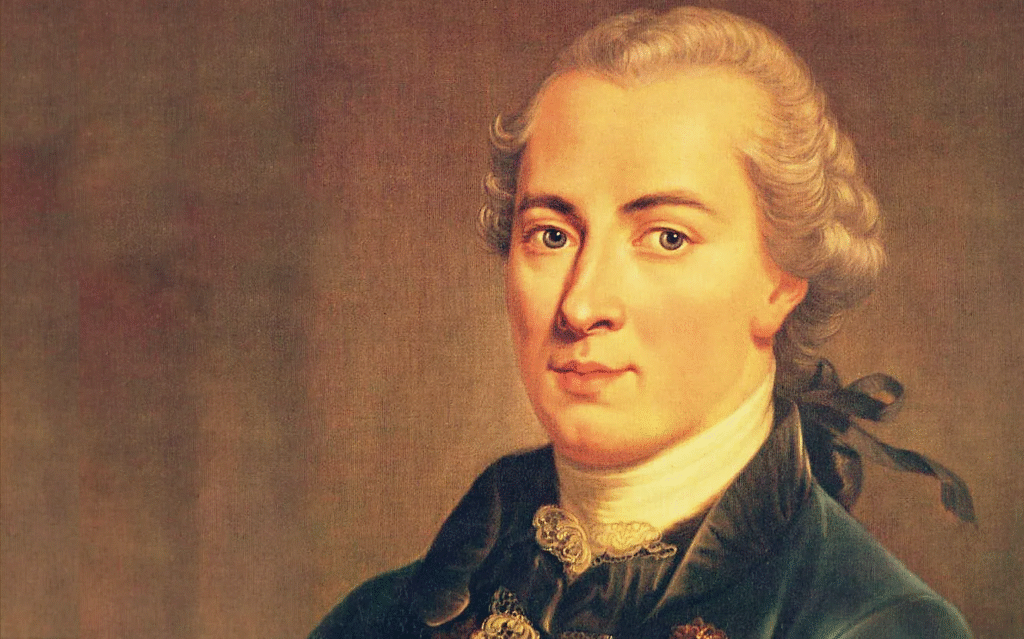
Few figures in the history of philosophy have exercised an influence as vast and enduring as Immanuel Kant (1724–1804). His intellectual revolution in the late eighteenth century transformed not only metaphysics and epistemology but also ethics, aesthetics, and the philosophy of religion. Kant stands at the crossroads of the Enlightenment and modern philosophy — a thinker who both consummated the rationalist and empiricist traditions and transcended them through what he called his “Copernican turn” in thought.
To understand Kant is to engage with the problem of human reason itself: what it can know, what it must do, and what it may hope for. His project was nothing less than a complete critique of reason — a systematic inquiry into the powers and limits of the human mind. Through this, Kant sought to establish a firm foundation for knowledge, morality, and faith without appeal to dogma or skepticism. His philosophy remains one of the great monuments of human intellect, combining scientific precision with moral grandeur.
Check new book – The Life and Philosophy of Immanuel Kant
Life and Background
Immanuel Kant was born on April 22, 1724, in Königsberg, the capital of East Prussia (now Kaliningrad, Russia). He was the fourth of nine children in a modest family of artisans. His father, Johann Georg Kant, was a harness-maker, and his mother, Anna Regina, was deeply pious and known for her integrity and devotion. The household atmosphere reflected the strict Pietist faith of the time — a Protestant movement emphasizing moral rigor, self-discipline, and inner piety. These early influences left a permanent mark on Kant’s character, fostering in him a sense of duty and a moral seriousness that would later form the foundation of his ethics.
Kant attended the Collegium Fridericianum, a Pietist school where he received a rigorous education in Latin, theology, and classical studies. In 1740 he entered the University of Königsberg, where he studied philosophy, mathematics, and natural science under Martin Knutzen, a follower of Leibniz and Wolff. Knutzen introduced Kant to the emerging Newtonian worldview, awakening his interest in physics and metaphysics alike.
After the death of his father, Kant interrupted his studies and spent nearly a decade (1746–1755) as a private tutor in various Prussian households. During these years, he read voraciously and wrote his first scientific and philosophical essays, including Thoughts on the True Estimation of Living Forces (1747). When he returned to the university in 1755, he earned his doctorate and began lecturing as a Privatdozent — an unpaid lecturer who lived on student fees.
For more than forty years Kant rarely left Königsberg. He led a life of exemplary regularity and intellectual discipline. His daily routine became legendary: he rose at five, lectured and wrote in the morning, dined at two, and walked every afternoon at the same hour along the city’s Lindenallee — so punctual, it was said, that residents could set their clocks by his passing. Behind this almost mechanical regularity, however, lay a mind of extraordinary energy and originality.
Kant remained in Königsberg until his death on February 12, 1804, at the age of seventy-nine. He never married, never traveled more than a few miles from his birthplace, and yet his thought would travel across the world, shaping the course of philosophy for centuries.
The Historical Context
Kant’s lifetime coincided with the height of the European Enlightenment — a period marked by confidence in human reason, the progress of science, and the decline of traditional metaphysics. The two dominant schools of thought that Kant inherited were rationalism and empiricism.
- The rationalists — notably René Descartes, Baruch Spinoza, and Gottfried Wilhelm Leibniz — argued that genuine knowledge arises from the intellect, from clear and distinct ideas grasped through reason alone. They believed that the mind could deduce truths about the world a priori, independent of experience.
- The empiricists — especially John Locke, George Berkeley, and David Hume — denied this, insisting that all knowledge originates in sensory experience. For them, the mind at birth was a tabula rasa, and all ideas were ultimately derived from impressions.
Kant saw both traditions as incomplete. Rationalism, he believed, overestimated reason’s powers, constructing metaphysical systems detached from experience. Empiricism, on the other hand, reduced thought to a mere play of sensations and habits, leaving no room for necessity or universality in knowledge. David Hume’s skepticism — his claim that the notion of cause and effect was merely a habit of association — jolted Kant into his lifelong project. As Kant later confessed, “It was Hume who awoke me from my dogmatic slumber.”
The question that haunted Kant was this: How is knowledge possible? How can human understanding produce judgments that are both synthetic (adding to our knowledge) and a priori (known independently of experience)? His answer would redefine philosophy itself.
The Critical Philosophy
Kant’s mature thought is contained in three monumental works, collectively known as the three Critiques:
- Critique of Pure Reason (Kritik der reinen Vernunft, 1781; 2nd ed. 1787)
- Critique of Practical Reason (Kritik der praktischen Vernunft, 1788)
- Critique of Judgment (Kritik der Urteilskraft, 1790)
Each corresponds to one of the fundamental powers of the human mind — cognition, will, and feeling — or, as Kant put it, to the three questions of philosophy: What can I know? What ought I to do? What may I hope for?
The Critique of Pure Reason
The Critique of Pure Reason is among the most difficult yet rewarding works in Western thought. Its central aim is to investigate the limits and conditions of human knowledge — to determine what we can know a priori and what lies beyond our reach.
The Copernican Revolution
Kant proposed a radical shift in perspective, often compared to Copernicus’s revolution in astronomy. Before Copernicus, it was assumed that the observer revolved around the world; Copernicus realized that the world appears as it does because it revolves relative to the observer. Likewise, Kant argued that objects conform to our way of knowing them, not the reverse. We do not perceive things as they are in themselves (noumena), but as they appear to us (phenomena), shaped by the forms and categories of our own mind.
Space, Time, and the Categories
According to Kant, the mind contributes two a priori forms of sensibility — space and time — which structure all our perceptions. They are not properties of things but of our sensibility itself; they are the lenses through which we experience the world.
Beyond these, the understanding (or intellect) supplies the categories — fundamental concepts such as unity, causality, substance, and necessity — which organize sensory data into coherent experience. The world we know, therefore, is the world as constituted by our cognitive faculties.
Phenomena and Noumena
The distinction between phenomena (things as they appear) and noumena (things in themselves) is central to Kant’s philosophy. While we can know phenomena through the interaction of sense and understanding, the noumenal realm remains unknowable. We can think of it, but we cannot experience it. This limitation marks the boundary of human reason. By drawing this line, Kant sought to secure both scientific knowledge (within the realm of experience) and faith (beyond it).
The Antinomies of Reason
When reason tries to transcend the limits of experience — to speculate about the universe as a whole, about the soul or God — it falls into contradictions, or antinomies. For example, it can prove both that the world has a beginning in time and that it has existed eternally. Kant’s resolution is to show that such conflicts arise only when we mistake the conditions of experience for properties of things in themselves.
Through this critique, Kant destroyed the pretensions of dogmatic metaphysics while preserving the possibility of objective knowledge within experience. He described his philosophy as transcendental idealism: the view that while objects depend on our forms of knowledge, they are nonetheless real as appearances.
The Critique of Practical Reason
If the first Critique limits what we can know, the second concerns what we ought to do. Here Kant develops his moral philosophy, grounded in the autonomy of reason.
For Kant, moral law does not come from divine command, social convention, or inclination; it arises from reason itself. To act morally is to act according to a law that one could will to be universal — the categorical imperative. Its most famous formulation is:
“Act only according to that maxim whereby you can at the same time will that it should become a universal law.”
Moral worth lies not in the consequences of an action but in the motive of duty. To act from duty is to act out of respect for the moral law, not for reward or pleasure. Freedom, for Kant, consists precisely in this self-legislation — the capacity of the rational will to determine itself according to universal principles.
This ethical doctrine has had immense influence. It provided the foundation for modern deontological ethics and inspired later moral philosophers from Fichte and Hegel to Rawls and Habermas. Kant’s emphasis on human dignity and autonomy also became central to modern conceptions of rights and justice.
The Critique of Judgment
In his third Critique, Kant turned to aesthetics and teleology — the philosophy of beauty and purpose. He sought to bridge the gulf between the deterministic laws of nature (studied in the first Critique) and the freedom of moral will (affirmed in the second).
Aesthetic judgment, Kant argued, is unique. When we call something “beautiful,” we do not refer to its utility or concept, but to the disinterested pleasure we take in its form. The experience of beauty reveals the harmony between imagination and understanding, suggesting a deeper unity between the natural and moral worlds.
In the same work, Kant explored teleology, the study of ends or purposes in nature. While science explains phenomena through causation, living organisms seem to display purposive organization. Kant concluded that we may regard nature as if it were purposive, though we cannot prove it to be so. This “as if” standpoint reconciles the mechanical and the moral orders under the reflective power of judgment.
Religion and the Limits of Reason
Kant’s later works, particularly Religion within the Boundaries of Mere Reason (1793), extend his critical method to theology. He argued that true religion is the recognition of moral law as divine command — that faith must be rooted in ethical life rather than dogma. For him, religious symbols express moral truths allegorically. God, freedom, and immortality are not objects of knowledge but postulates of practical reason — ideas necessary to sustain moral striving.
This position angered the Prussian authorities. The reactionary minister Wöllner accused Kant of undermining Christianity, and in 1794 the philosopher received a royal order forbidding him from writing or lecturing on religion. Kant obeyed the letter of the command but resumed his religious reflections after the king’s death. His defense of moral autonomy against clerical control made him a symbol of Enlightenment freedom.
Kant’s Legacy
Kant’s influence was immediate and far-reaching. Within decades, German philosophy transformed itself under his shadow.
- Johann Gottlieb Fichte emphasized the active role of the self, turning Kant’s transcendental idealism into a philosophy of absolute ego.
- Friedrich Schelling and Georg Wilhelm Friedrich Hegel developed German Idealism, seeking to overcome Kant’s separation of phenomenon and noumenon through dialectical systems that unified thought and being.
- Arthur Schopenhauer reinterpreted the noumenon as the blind “will to life.”
- In the twentieth century, phenomenology, existentialism, analytic philosophy, and neo-Kantianism each rediscovered aspects of Kant’s critical project.
Kant also profoundly influenced the development of modern science, psychology, and aesthetics. His view of knowledge as structured by mental categories anticipated cognitive psychology, while his aesthetics shaped Romanticism and modern theories of art. Politically, his essay Perpetual Peace (1795) proposed a federation of free states under cosmopolitan law, foreshadowing the ideals of the League of Nations and the United Nations.
The Character of Kant
Beyond his writings, Kant’s personal character embodied the moral rigor of his philosophy. Contemporaries described him as modest, courteous, and intellectually fearless. His conversation was lively and urbane, his manners precise yet humane. He was deeply devoted to truth and reason, yet tolerant of differing opinions.
In old age, as his health declined, he faced mental exhaustion with quiet dignity. His last recorded words, “Es ist gut” (“It is good”), seemed to express his lifelong faith in the rational order of the world. Shortly after his death, his epitaph was engraved on his tomb in Königsberg, quoting his own words from the Critique of Practical Reason:
“Two things fill the mind with ever new and increasing admiration and awe: the starry heavens above me and the moral law within me.”
The Enduring Significance of Kant
Kant’s philosophy remains a touchstone for modern thought because it addresses the permanent questions of human existence.
- Knowledge and Reality — Kant showed that knowledge is an active construction, not a passive reflection. The mind brings order to experience, shaping reality through its forms and categories. This insight continues to influence cognitive science, epistemology, and philosophy of mind.
- Freedom and Morality — By grounding ethics in autonomy, Kant provided a secular, universal basis for morality. His idea that every rational being is an end in itself underlies the modern concept of human rights.
- Faith and Reason — Kant reconciled moral faith with critical reason. He denied knowledge of God but affirmed belief as a practical necessity — a moral hope rather than a speculative certainty.
- Aesthetics and Meaning — His analysis of beauty as a disinterested harmony of faculties continues to shape discussions of art and the experience of value.
Perhaps Kant’s most enduring contribution is his insistence that reason must critique itself — that philosophy’s highest task is to examine the very faculties by which it seeks knowledge. In this self-limitation lies freedom: the freedom to know what is knowable and to act morally within the bounds of human finitude.
Conclusion
Immanuel Kant stands as a monumental figure in the history of human thought — a philosopher who united the rigor of science with the dignity of moral purpose. His Critiques reshaped metaphysics, his ethics redefined morality, and his vision of reason provided a foundation for the modern age.
Kant did not seek to build a metaphysical system that would explain everything. Instead, he sought to understand the conditions that make explanation itself possible. He called upon humanity to think for itself, to recognize the autonomy of reason, and to live according to principles that could be universal.
In doing so, Kant captured the very spirit of the Enlightenment: the courage to use one’s own understanding. More than two centuries later, his philosophy continues to challenge and inspire — reminding us that the pursuit of knowledge and the pursuit of moral integrity are two sides of the same human vocation.
As long as questions about truth, freedom, and duty endure, the voice of Kant will remain present — calm, demanding, and luminous — guiding reason toward its rightful limits and its noblest aims.