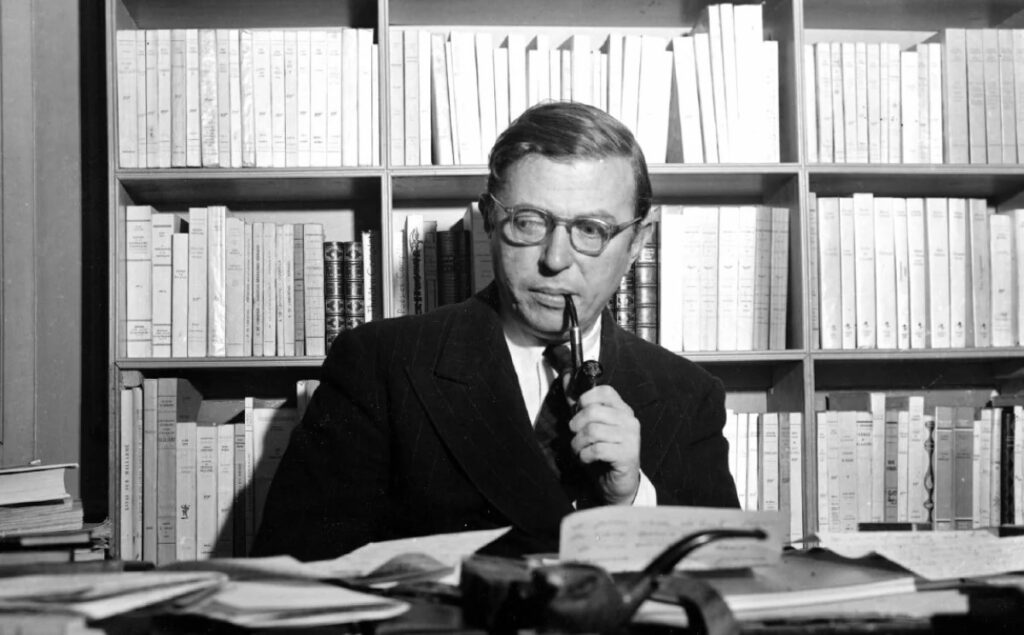
Jean-Paul Sartre was one of the most influential philosophers and writers of the twentieth century. His work spans philosophy, novels, plays, political essays, and autobiography, and together these writings form one of the most significant intellectual legacies of modern Europe. Sartre is most closely associated with existentialism, a philosophical movement that emphasizes human freedom, responsibility, and the absence of predetermined meaning in the world. Through both philosophical argument and literary storytelling, he explored what it means for individuals to create their own values in a universe that offers no inherent moral or metaphysical structure.
Unlike many philosophers who wrote only technical treatises, Sartre believed that philosophy should engage directly with human experience. For this reason he expressed his ideas through multiple genres. His philosophical works analyze consciousness, freedom, and social relations in systematic terms, while his novels and plays portray these same themes through characters struggling with difficult choices and uncertain circumstances. In Sartre’s view, literature could reveal existential dilemmas in a concrete and emotionally compelling way that purely abstract philosophy could not fully capture.
Sartre’s writings also reflect the turbulent historical context in which he lived. The political crises of the twentieth century, including war, occupation, and ideological conflict, shaped his understanding of freedom and responsibility. Many of his works explore how individuals respond to oppressive systems, social expectations, and historical forces that seem to limit personal autonomy. Through these reflections, Sartre sought to show that human beings remain responsible for their actions even in difficult or constrained situations.
The following list presents some of Jean-Paul Sartre’s most important books. These works include both philosophical studies and literary creations, each offering insight into the development of his ideas and his broader intellectual project. Together they illustrate how Sartre attempted to confront fundamental questions about existence, meaning, and human freedom.
List of Jean-Paul Sartre Books:
Nausea (1938)
This philosophical novel is Sartre’s first major literary work and one of the earliest expressions of existentialist thought in fiction. The story follows Antoine Roquentin, a historian who experiences a profound sense of alienation from the world around him. Everyday objects and events begin to appear strange and meaningless, producing a feeling he calls “nausea.” Through this narrative, Sartre explores themes of contingency, freedom, and the unsettling realization that existence has no inherent purpose.
The Imaginary (1940)
In this philosophical study, Sartre examines the nature of imagination and mental imagery. The book investigates how human consciousness creates images that are not present in reality. Sartre argues that imagination is not simply a reproduction of perception but a creative act of consciousness that negates the present world and introduces possibilities. This work contributed to early twentieth-century debates about perception, phenomenology, and the structure of consciousness.
Being and Nothingness (1943)
Often considered Sartre’s most important philosophical work, this book presents a comprehensive analysis of human existence. Sartre develops his existential ontology by distinguishing between “being-in-itself,” the existence of objects, and “being-for-itself,” the conscious existence of human beings. The work explores freedom, responsibility, bad faith, and the role of others in shaping self-awareness. It is one of the central texts of existentialist philosophy.
The Age of Reason (1945)
The first novel in Sartre’s trilogy The Roads to Freedom, this book follows Mathieu Delarue, a philosophy teacher struggling with questions about freedom, responsibility, and personal commitment. Set in pre-war France, the novel portrays characters attempting to define their lives in a world marked by uncertainty and political tension. Sartre uses the narrative to explore existential themes in everyday situations.
The Reprieve (1945)
The second volume of The Roads to Freedom trilogy, this novel takes place during the Munich crisis of 1938. Instead of focusing on a single protagonist, the narrative shifts between multiple characters across Europe. Through these intertwined perspectives, Sartre depicts the anxiety and anticipation that accompanied the looming threat of war.
Iron in the Soul (1949)
The third novel in The Roads to Freedom series, this work examines the collapse of France during the German invasion in 1940. The characters confront the consequences of their choices and the limits of their freedom under conditions of war and defeat. Sartre portrays how historical events reshape personal identity and moral responsibility.
Existentialism Is a Humanism (1946)
This short philosophical book originated as a public lecture. Sartre defends existentialism against critics who accused it of promoting despair or moral chaos. He argues that existentialism affirms human freedom and responsibility. According to Sartre, because there is no predetermined human nature, individuals must create their own values through their actions.
Anti-Semite and Jew (1946)
In this essay, Sartre analyzes the psychology and social dynamics of antisemitism. He argues that antisemitism is not primarily based on rational belief but on emotional attitudes and social identity. The work examines prejudice as a phenomenon shaped by historical conditions and personal motivations rather than factual misunderstanding.
What Is Literature? (1947)
This book explores the role and responsibility of writers in society. Sartre argues that literature is a form of engagement with the world. Writers must confront social and political realities rather than retreat into purely aesthetic concerns. The work reflects Sartre’s belief that intellectual activity carries ethical and political responsibility.
Critique of Dialectical Reason (1960)
This ambitious philosophical work attempts to reconcile existentialism with Marxism. Sartre analyzes how individual freedom interacts with historical and social structures. The book explores concepts such as collective action, scarcity, and social conflict. It represents Sartre’s effort to integrate existential philosophy with political theory.
The Words (1964)
This autobiographical work reflects on Sartre’s childhood and intellectual development. The book examines how literature shaped his early understanding of the world. Rather than presenting a conventional memoir, Sartre offers a philosophical reflection on the relationship between writing, identity, and self-creation.
Summary
Taken together, the books of Jean-Paul Sartre reveal a thinker who used multiple forms of writing to explore a single philosophical problem: how human beings live and make choices in a world without predetermined meaning. Rather than separating philosophy from literature, Sartre deliberately moved between theoretical analysis and narrative expression. His philosophical works examine the structure of consciousness, freedom, and responsibility, while his novels and plays portray individuals confronting these same ideas in concrete situations.
One of the distinctive features of Sartre’s intellectual project is the emphasis on human freedom. He argued that individuals are not defined by fixed essences or predetermined roles. Instead, people continually shape themselves through their actions and decisions. This idea places an extraordinary weight on personal responsibility. According to Sartre, every choice contributes not only to the individual life of the person making it but also to the broader understanding of what it means to be human.
Another recurring theme throughout his books is the tension between freedom and circumstance. Sartre did not deny that human beings exist within social, historical, and political conditions that limit their options. However, he insisted that even within such constraints, individuals remain responsible for how they respond. His works often explore situations in which characters face pressure from society, relationships, or historical events, yet must still decide how to act.
Sartre also examined the role of other people in shaping self-awareness. Human identity, in his view, is not formed in isolation. The presence of others introduces recognition, conflict, and judgment. Many of his philosophical discussions analyze how individuals perceive themselves through the eyes of others and how this interaction influences personal freedom. This concern with interpersonal relations appears both in his theoretical writing and in the dramatic conflicts depicted in his fiction.
In addition to existential questions about freedom and identity, Sartre books frequently engage with political and social issues. He believed that intellectual life carries ethical responsibility and that writers should address the realities of their time. His later works increasingly reflect attempts to understand how individual freedom interacts with broader historical forces such as class conflict, political ideology, and collective action.
Sartre’s influence extended far beyond philosophy departments. His ideas shaped literature, political theory, psychology, and cultural criticism. During the mid twentieth century he became one of the most prominent public intellectuals in Europe, participating actively in debates about politics, colonialism, and social justice. Even readers who approach his work primarily through fiction encounter the philosophical questions that guided his thinking.
The enduring significance of Sartre books lies in their exploration of the human condition under modern circumstances. They confront a world in which traditional religious and metaphysical frameworks no longer provide clear answers about meaning or purpose. Rather than offering a new system of certainty, Sartre’s writings emphasize the responsibility that arises when individuals recognize that meaning must be created rather than discovered.
For this reason, Sartre remains a central figure in discussions of modern philosophy and literature. His works continue to invite readers to examine the relationship between freedom, responsibility, and the social world in which human lives unfold.