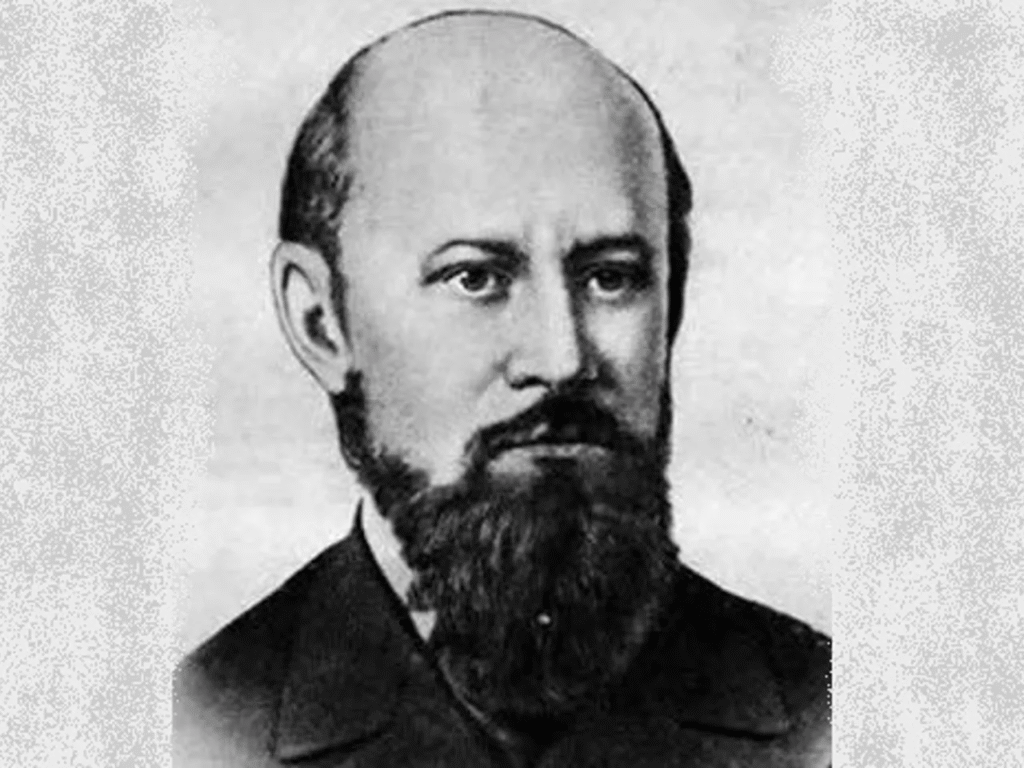
Mikhail Mikhailovich Filippov (1858–1903) belongs to the group of Russian scholars who helped introduce systematic European philosophy to a wider Russian reading public during the final decades of the nineteenth century. His name is not as widely known today as that of V. S. Solovyov, P. A. Florensky, or other major figures of the Silver Age, yet Filippov’s contribution to the intellectual environment of his time was real. He wrote at a moment when Russian readers were searching for clear expositions of Western philosophical systems. Filippov’s role was that of an interpreter and mediator. He was not a creator of a large philosophical system of his own, but a thoughtful scholar with a evident commitment to accuracy and readability. Among his works, his book on Immanuel Kant occupies a central place, since it offered one of the first substantial Russian introductions to Kant’s life and thought written in a form suitable for a broad educated audience.
Filippov received a solid academic education and belonged to the generation of Russian thinkers who believed that philosophy should be understood as a rational, historical, and cultural task. His orientation was European. He saw the philosophical tradition of the West as a continuous chain of attempts to understand human reason, moral life, and the structure of reality. At the same time, he recognized the need to transmit these ideas in a form that was accessible to readers outside the narrow university world. His writings show concern for clarity, precision, and pedagogical effectiveness. This approach makes him comparable to the group of Russian scholars and translators who expanded the philosophical vocabulary of the Russian language and prepared the ground for the more original developments of the later Silver Age.
Little information survives about Filippov’s personal life, yet his published works testify to a serious scholarly discipline and broad erudition. He moved easily among different philosophical traditions. His essays reveal familiarity with German idealism, British empiricism, French moral philosophy, and classical sources. His interest in individual thinkers was never superficial. When he approached a philosopher, he read with care, traced the development of the ideas, and attempted to understand the thinker’s historical context. In this respect Filippov can be called a historian of philosophy who believed that each system must be interpreted within its intellectual environment.
His study of Kant demonstrates this method especially well. The book is both biographical and systematic. It begins with a detailed account of Kant’s early life in Königsberg. Filippov describes the strict Pietist background of Kant’s youth, the intellectual conditions of Prussia, and the daily discipline that shaped Kant’s character. These sections give readers an image of Kant not simply as a creator of difficult philosophical texts, but as a human being formed by specific circumstances. Filippov wanted to show that the development of Kant’s critical philosophy cannot be separated from the man who wrote the works. The book weaves personal detail with intellectual analysis. It explains how Kant’s habits, temperament, and even his well known punctuality emerged from a worldview that valued order, reason, and duty.
Filippov then proceeds to outline the main stages of Kant’s philosophical development. He explains the significance of the early works, the gradual movement from dogmatic metaphysics to critical thought, and the decisive role of the encounter with Hume. In his exposition Filippov avoids unnecessary technicality. Instead he concentrates on the structure of Kant’s main works and the central problems they address. His treatment of the synthetic a priori, the forms of sensibility, the categories, and the relation of appearance and thing in itself is balanced and measured. He understands that the purpose of the book is not to argue for or against Kant, but to present Kant’s system in a way that a non specialist can understand.
One of the strengths of Filippov’s Kant biography is his attention to the unity of the critical project. He makes clear that Kant’s work is not a collection of separate theories, but a coherent system that includes theoretical philosophy, practical philosophy, and aesthetic judgment. Filippov shows that Kant’s concept of reason is the foundation of all three parts. He explains that the limits placed on theoretical knowledge do not undermine the value of moral action or aesthetic experience. Instead they prepare the ground for a deeper understanding of human dignity and the place of rational beings in the world. Filippov’s presentation of Kant’s moral philosophy is especially clear. He describes the role of the moral law, the idea of autonomy, and the categorical imperative in a simple and direct style. He emphasizes the importance of duty, respect, and universal principles in Kant’s ethics. He does not overload the discussion with specialized terminology. His goal is elucidation rather than controversy.
Filippov also devotes considerable attention to Kant’s later years. He recounts the conflict between Kant and the Prussian authorities, the censorship of the work on religion, and the dignified response Kant gave when threatened. This part of the biography was important for Russian readers of Filippov’s time. It provided an example of intellectual integrity in the face of external pressure. Filippov presents Kant as a person guided by conscience, committed to truth, and unwilling to compromise his principles even when confronted by political authority. The story had resonance in a Russian society where censorship and state control were familiar realities. Filippov saw Kant not only as a philosopher, but as a moral example for those who value freedom of thought.
Filippov’s admiration for Kant is evident throughout the biography, but it does not lead him to uncritical praise. He is aware of the limitations and difficulties of Kant’s system. He mentions the abstract style of the major works, the complex terminology, and the challenges readers face when approaching the Critiques. Yet he maintains that Kant’s achievement lies precisely in the attempt to establish the boundaries of reason with rigor and honesty. For Filippov, Kant’s great service to philosophy was the discovery of the conditions of knowledge and the clarification of the limits of metaphysical speculation. This achievement prepared the intellectual landscape of the nineteenth century. Filippov emphasizes that German idealism, positivism, neo Kantianism, and other later philosophical movements cannot be understood without reference to Kant’s critical revolution.
The significance of Filippov’s biography therefore extends beyond the presentation of one thinker. It represents a moment in Russian intellectual history when systematic European thought was being assimilated and interpreted for local readers. The Russian university environment of the nineteenth century was oriented toward German scholarship. Kant’s works were central to this orientation. Filippov’s task was to bring Kant out of the narrow academic sphere and into general educated culture. He succeeded in this task by writing in a way that combined accuracy with literary clarity.
Filippov’s broader work in philosophy followed a similar pattern. He wrote essays on the relation of religion and morality, on the development of philosophical ideas in Europe, and on the significance of modern thinkers. He translated and commented on several authors. His interest in Nietzsche, for example, shows his ability to engage with new movements without dismissing them. He treated Nietzsche as a serious critic of European culture and not as a writer of sensational slogans. This attitude reflects Filippov’s commitment to fair and balanced interpretation. He respected the autonomy of each philosopher even when he disagreed with the views expressed.
Filippov’s later career was marked by steady scholarly activity. He contributed to journals, wrote monographs, and participated in the general intellectual life of his time. His death in 1903 ended a career that, while not widely celebrated, played an important role in shaping the philosophical culture of pre revolutionary Russia. Many authors of the early twentieth century, including religious thinkers, historians of philosophy, and translators, continued the path he helped open. They built upon his efforts to make European thought accessible while also developing original contributions of their own.
Today Filippov is remembered primarily through his published works. Among these, the biography of Kant stands out as the most influential. It remains a valuable introduction to the life and thought of one of the central figures of modern philosophy. The book has historical interest as a document of Russian philosophical reception. It also has pedagogical value because of the clarity of its explanations and the balance of its perspective. Students and general readers who encounter Kant for the first time often find Filippov’s narrative easier to approach than technical academic commentaries. The biographical chapters provide human context. The philosophical chapters outline the main ideas with precision but without unnecessary complication.
Filippov’s work continues to receive attention from scholars who study the transmission of German philosophy into Russian culture. His Kant biography serves as evidence of the respect Russian thinkers had for the critical tradition. It also illustrates the desire to place philosophy in a broader cultural setting. Filippov saw Kant not only as a theorist of knowledge, but as a figure whose moral seriousness could address questions meaningful to Russian readers. The book therefore belongs to the history of Russian humanism as well as to the history of Russian philosophy.
To read Filippov today is to encounter a voice shaped by the values of the nineteenth century: clarity of expression, fidelity to sources, and a belief in the moral significance of intellectual life. His commitment to presenting Kant’s ideas without distortion reflects his larger conviction that philosophy serves as a guide for the thoughtful person. He believed that human reason, properly used, leads not only to understanding, but to ethical self determination. He admired Kant because Kant formulated this conviction with unmatched precision.
Filippov’s achievement lies in the ability to bring this precision into a narrative form. He wrote in a way that speaks to the individual reader rather than to the specialist alone. His biography of Kant is an example of how philosophical ideas can be communicated in an accessible and dignified manner. Through his work, generations of Russian readers encountered one of the greatest thinkers of the Western tradition.
In the landscape of Russian intellectual history, Mikhail Mikhailovich Filippov occupies a modest but important position. He was a translator of ideas, a teacher of philosophical clarity, and a writer who believed in the transformative power of reason. His book on Kant remains the best evidence of his method and his contribution. It stands as a bridge between Russian culture and the legacy of Immanuel Kant, a legacy that continues to shape discussions of knowledge, morality, and human dignity.