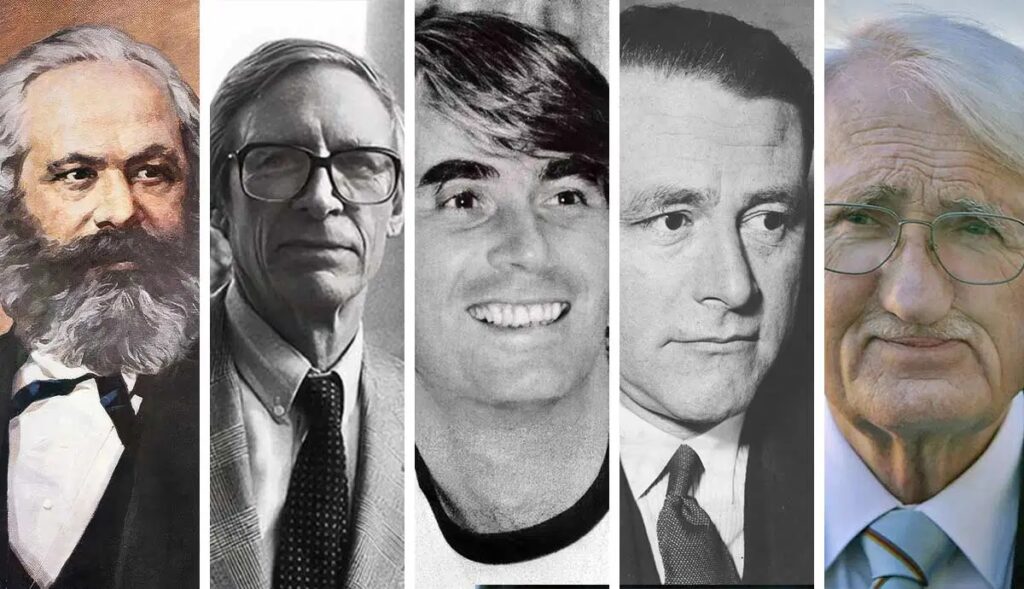
Modern philosophers emerge from a historical and intellectual rupture. They work in a world where inherited authorities no longer provide unquestioned foundations for truth, morality, or meaning. Unlike ancient or medieval thinkers, modern philosophers do not begin from a shared metaphysical order or a unified religious framework. Their starting point is critique. Philosophy becomes responsible for justifying its own principles rather than receiving them from tradition.
A defining feature of modern philosophers is their concern with the limits of reason. Knowledge is no longer treated as a simple correspondence between mind and reality. Instead, philosophers ask how knowledge is possible, what conditions make understanding reliable, and where reason must acknowledge its boundaries. This shift turns philosophy inward. The examination of thought itself becomes a central philosophical task.
Modern philosophers place the human subject at the center of inquiry. Consciousness, selfhood, autonomy, and responsibility become fundamental philosophical problems. The individual is no longer understood primarily as a part of a cosmic or divinely ordered whole, but as an agent who must orient himself or herself in a world that does not supply ready made meaning. This emphasis on subjectivity introduces a permanent tension into modern thought: human beings gain intellectual freedom while also bearing the burden of justification for their beliefs and actions.
Ethics is transformed accordingly. Moral norms are no longer grounded in tradition, revelation, or social custom alone. Modern philosophers seek rational, psychological, historical, or social foundations for moral obligation. Some emphasize universal principles, others focus on consequences, social practices, or lived experience. What unites these approaches is the rejection of unexamined morality. Ethical life becomes something that must be argued for and consciously maintained.
Another defining trait of modern philosophers is their close relationship with science. Scientific revolutions challenge older metaphysical explanations and force philosophy to reconsider concepts such as causality, objectivity, truth, and explanation. Philosophy no longer claims to provide scientific knowledge, but it examines the assumptions and limits of scientific reasoning. In doing so, modern philosophy clarifies where scientific explanation ends and philosophical reflection begins.
Politics becomes an unavoidable domain of philosophical inquiry. Modern philosophers confront questions of power, legitimacy, law, rights, and social organization in a world shaped by revolutions, industrialization, and mass society. Political philosophy is no longer speculative idealization. It becomes analysis of real institutions, historical forces, and their moral consequences. Ideas are treated as forces that shape social reality, not as abstractions detached from life.
Modern philosophers also display an unprecedented diversity of methods and styles. Some construct systematic frameworks, others work through historical interpretation, logical analysis, phenomenological description, or critique of language and power. There is no single authoritative method. Disagreement is not an accident but a structural feature of modern philosophy. The absence of consensus is itself a consequence of philosophy’s critical stance.
Despite their differences, modern philosophers share a commitment to seriousness and intellectual responsibility. Philosophy is not entertainment, opinion, or self expression. It is disciplined thinking under conditions where certainty cannot be assumed. Modern philosophy rejects both dogmatism and intellectual complacency. It demands argument, clarity, and willingness to revise one’s views.
Modern philosophers are also acutely aware of the consequences of ideas. The catastrophes and transformations of modern history make it impossible to treat philosophy as harmless speculation. Concepts influence institutions, justify actions, and legitimize power. Thinking itself becomes a moral activity, bound to responsibility for how ideas are used or misused.
For the contemporary reader, modern philosophers do not offer comfort or final answers. They offer orientation. They sharpen judgment, expose hidden assumptions, and clarify alternatives. Their value lies not in consensus, but in cultivating the capacity to think responsibly in a world where responsibility cannot be avoided.
In this sense, modern philosophers are defined less by when they lived than by how they thought. They accept uncertainty as a permanent condition and treat critique not as destruction, but as the necessary discipline of reason in modern life.
List of 100 Modern Philosophers
- Immanuel Kant (1724–1804) – Germany
- Jeremy Bentham (1748–1832) – England
- Johann Gottlieb Fichte (1762–1814) – Germany
- Georg Wilhelm Friedrich Hegel (1770–1831) – Germany
- Arthur Schopenhauer (1788–1860) – Germany
- Auguste Comte (1798–1857) – France
- John Stuart Mill (1806–1873) – United Kingdom
- Søren Kierkegaard (1813–1855) – Denmark
- Karl Marx (1818–1883) – Germany
- Friedrich Engels (1820–1895) – Germany
- Herbert Spencer (1820–1903) – England
- Charles Sanders Peirce (1839–1914) – United States
- William James (1842–1910) – United States
- Friedrich Nietzsche (1844–1900) – Germany
- Edmund Husserl (1859–1938) – Germany
- Henri Bergson (1859–1941) – France
- John Dewey (1859–1952) – United States
- Alfred North Whitehead (1861–1947) – United Kingdom
- George Santayana (1863–1952) – Spain / United States
- Bertrand Russell (1872–1970) – United Kingdom
- G. E. Moore (1873–1958) – United Kingdom
- Ernst Cassirer (1874–1945) – Germany
- Max Scheler (1874–1928) – Germany
- José Ortega y Gasset (1883–1955) – Spain
- Karl Jaspers (1883–1969) – Germany
- Ludwig Wittgenstein (1889–1951) – Austria
- Martin Heidegger (1889–1976) – Germany
- Antonio Gramsci (1891–1937) – Italy
- Walter Benjamin (1892–1940) – Germany
- Roman Ingarden (1893–1970) – Poland
- Herbert Marcuse (1898–1979) – Germany
- Gilbert Ryle (1900–1976) – United Kingdom
- Hans-Georg Gadamer (1900–2002) – Germany
- Erich Fromm (1900–1980) – Germany
- Karl Popper (1902–1994) – Austria / United Kingdom
- Theodor W. Adorno (1903–1969) – Germany
- Jean-Paul Sartre (1905–1980) – France
- Hannah Arendt (1906–1975) – Germany / United States
- Simone de Beauvoir (1908–1986) – France
- Maurice Merleau-Ponty (1908–1961) – France
- Isaiah Berlin (1909–1997) – United Kingdom
- A. J. Ayer (1910–1989) – United Kingdom
- Albert Camus (1913–1960) – France
- Paul Ricoeur (1913–2005) – France
- Herbert Simon (1916–2001) – United States
- Peter Strawson (1919–2006) – United Kingdom
- John Rawls (1921–2002) – United States
- Thomas Kuhn (1922–1996) – United States
- Cornelius Castoriadis (1922–1997) – Greece / France
- Jean-François Lyotard (1924–1998) – France
- Paul Feyerabend (1924–1994) – Austria
- Gilles Deleuze (1925–1995) – France
- Michel Foucault (1926–1984) – France
- Hilary Putnam (1926–2016) – United States
- Leszek Kołakowski (1927–2009) – Poland
- Jürgen Habermas (1929– ) – Germany
- Bernard Williams (1929–2003) – United Kingdom
- Alasdair MacIntyre (1929–2025) – Scotland
- Jean Baudrillard (1929–2007) – France
- Jacques Derrida (1930–2004) – France
- Hannah Pitkin (1931–2016) – United States
- Richard Rorty (1931–2007) – United States
- Charles Taylor (1931– ) – Canada
- Susan Sontag (1933–2004) – United States
- Amartya Sen (1933– ) – India
- Thomas Nagel (1937– ) – United States
- Alain Badiou (1937– ) – France
- Avishai Margalit (1939– ) – Israel
- Julia Kristeva (1941– ) – France
- Derek Parfit (1942–2017) – United Kingdom
- Roger Scruton (1944–2020) – United Kingdom
- Jean-Luc Marion (1946– ) – France
- Peter Singer (1946– ) – Australia
- Martha Nussbaum (1947– ) – United States
- Roberto Mangabeira Unger (1947– ) – Brazil
- Slavoj Žižek (1949– ) – Slovenia
- Axel Honneth (1949– ) – Germany
- Charles Mills (1951–2021) – Jamaica / United States
- Michael Sandel (1953– ) – United States
- Cornel West (1953– ) – United States
- Kwame Anthony Appiah (1954– ) – United Kingdom
- Judith Butler (1956– ) – United States
- Catherine Malabou (1959– ) – France
- Byung-Chul Han (1959– ) – Germany
- Simon Critchley (1960– ) – United Kingdom
- Nick Land (1962– ) – United Kingdom
- Alenka Zupančič (1966– ) – Slovenia
- Quentin Meillassoux (1967– ) – France
- Mark Fisher (1968–2017) – United Kingdom
- Graham Harman (1968– ) – United States
- Ray Brassier (1965– ) – United Kingdom
- Rebecca Goldstein (1950– ) – United States
- Patricia Churchland (1943– ) – Canada
- Daniel Dennett (1942–2024) – United States
- Saul Kripke (1940–2022) – United States
- Noam Chomsky (1928– ) – United States
- Ernesto Laclau (1935–2014) – Argentina
- Achille Mbembe (1957– ) – Cameroon
- Franco Berardi (1949– ) – Italy
- Yuk Hui (1980– ) – China
The time frame
Modern philosophy refers to a broad period in the history of thought defined not only by time but by a fundamental change in philosophical orientation. It emerges when philosophy no longer rests on inherited authority and instead turns critical attention toward the foundations of knowledge, morality, and meaning. The period commonly described as modern philosophy begins in the late eighteenth century and extends into the early or mid twentieth century.
Chronologically, modern philosophers are usually those born roughly between the 1720s and the end of the nineteenth century. The period begins after the Enlightenment has fully destabilized medieval and early modern frameworks grounded in theology, classical metaphysics, and unquestioned tradition. By this point, philosophy can no longer assume that reason reflects reality directly or that moral norms derive automatically from custom or divine command. These assumptions must be justified or abandoned.
The intellectual conditions that define modern philosophy matter more than exact dates. Modern philosophers work under the recognition that knowledge is problematic. Rather than asking only what the world is like, they ask how human beings can know anything at all and what limits reason must acknowledge. This shift transforms philosophy into a self critical enterprise. The examination of reason itself becomes central.
Another defining feature of modern philosophy is the rise of the human subject as a philosophical problem. Consciousness, autonomy, freedom, and responsibility take center stage. Human beings are no longer understood primarily as parts of a fixed cosmic order, but as agents who must orient themselves in a world that does not provide ready made meaning. This creates a tension that runs through modern philosophy: increasing freedom is accompanied by increasing responsibility.
Ethics also changes during this period. Moral norms are no longer accepted simply because they are traditional or authoritative. Modern philosophers seek rational, psychological, or social grounds for moral obligation. Some emphasize universal principles, others focus on consequences, historical context, or social relations. What unites these approaches is the refusal to treat morality as something beyond critique.
Modern philosophy develops in close dialogue with science. Scientific revolutions challenge older metaphysical explanations and force philosophy to rethink concepts such as causality, objectivity, truth, and explanation. Philosophy no longer competes with science by offering alternative explanations of nature. Instead, it examines the assumptions, scope, and limits of scientific reasoning.
Political thought becomes inseparable from philosophy in this period. Revolutions, industrialization, and the rise of mass society compel philosophers to address questions of power, law, legitimacy, rights, and social order. Political philosophy moves away from idealized visions and toward analysis of real institutions and historical forces. Ideas are treated as forces that shape social reality, not as abstractions detached from life.
By the early twentieth century, many of the tensions introduced by modern philosophy intensify. The scale of technological power, political catastrophe, and cultural fragmentation leads philosophy to further question reason, language, and meaning. At this point, many historians of philosophy begin to speak of contemporary philosophy rather than modern philosophy, though the boundary remains fluid and contested.
In this sense, modern philosophy occupies the period between inherited certainty and permanent plurality. It is defined by critique, responsibility, and the refusal to accept unexamined foundations. The time period of modern philosophers reflects this transformation: roughly from the late eighteenth century to the early or mid twentieth century, when philosophy learns to operate without final guarantees and accepts uncertainty as a condition rather than a failure of thought.