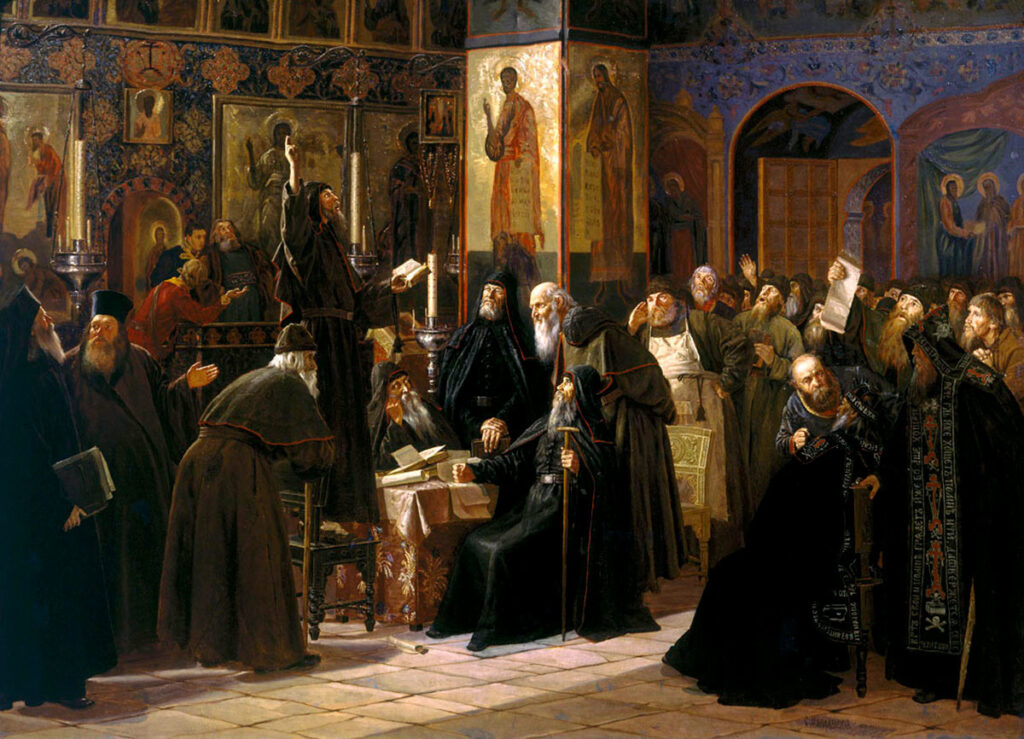
Russian religious philosophy occupies a distinctive place in the history of world thought. It developed at the intersection of Eastern Christian theology, European philosophical traditions, and the social and cultural crises of modern Russia. Its themes grew out of spiritual experience, moral reflection, and the search for cultural identity. The tradition formed gradually across several centuries, reached its full maturation during the Russian Silver Age, and continued to evolve in emigration after the revolution of 1917.
This article presents a comprehensive overview of the origins of Russian religious philosophy, the major thinkers associated with it, the central problems they addressed, and the cultural impact of their ideas. The narrative moves from early intellectual roots to the flowering of the classical period and concludes with the influence of this tradition on later scholarship.
Early Foundations: Patristic and Medieval Roots
The intellectual heritage of Russia was shaped by the Christianization of the Kievan Rus in the tenth century. From the beginning religious thought was based on the Eastern Christian tradition. Works of the Greek Church Fathers became central to education and spiritual life. Writers such as Basil the Great, Gregory of Nyssa, Gregory the Theologian, Maximus the Confessor, and John of Damascus influenced the Russian worldview. Their teachings provided the conceptual framework for understanding the human person, divine energies, moral life, and spiritual ascent.
In the early centuries Russian thinkers did not create systematic philosophical works. Instead they interpreted theological and moral questions through homilies, ascetic writings, and chronicles. The eleventh century saw figures such as Hilarion of Kiev, whose sermon on law and grace presented a synthesis of Christian theology and the emerging cultural consciousness of the new society. Another important figure was Theodosius of the Caves, whose writings emphasized humility, compassion, and community.
By the fifteenth century the intellectual climate matured. Philosophical themes appeared in discussions about monastic discipline, political authority, and spiritual authenticity. Nil Sorsky and the movement of non possessors argued for an inner spiritual life based on personal moral renewal. Joseph of Volokolamsk defended the role of monastic authority and the connection between church and state. These debates were theological in form but philosophical in spirit. They explored the foundations of freedom, moral responsibility, and the nature of truth within society.
Although medieval Russia did not produce philosophical systems comparable to those of Western scholasticism, it established the spiritual and intellectual foundations that later generations would transform into a comprehensive tradition.
The Eighteenth Century and the Encounter with European Thought
The reforms of Peter the Great and the influence of the Enlightenment brought a new intellectual atmosphere. Scientific academies, educational institutions, and translations of European works widened the horizon of Russian scholars. Philosophy as a university discipline entered Russian culture through this contact with the West.
Figures such as Feofan Prokopovich and later Mikhail Lomonosov played significant roles in this development. Lomonosov, while primarily a scientist and polymath, introduced rationalist ideas, natural philosophy, and the concept of lawful order in the universe. His work reflected the spirit of the Enlightenment.
During this period Russian religious thought faced a new challenge. European rationalism questioned traditional beliefs. At the same time, developments in German idealism and romanticism began to influence educated circles. Thinkers confronted the task of reconciling inherited spiritual experience with modern philosophical methods. The nineteenth century would provide the answer to this challenge.
The Nineteenth Century: Transformation and New Synthesis
Russian religious philosophy matured in the nineteenth century. The period brought social reforms, political unrest, and the rise of cultural self consciousness. Intellectuals sought a deeper understanding of the nature of truth, the meaning of human freedom, and the spiritual destiny of Russia.
Several figures shaped this period and prepared the ground for the flowering of the Silver Age.
The Slavophiles and the Philosophy of Community
The first major movement was Slavophilism. Although often described as a cultural and political trend, it also had a profound philosophical dimension. The key figures were Aleksey Khomyakov, Ivan Kireevsky, Konstantin Aksakov, and Yuri Samarin.
Aleksey Khomyakov developed the idea of sobornost, a concept of spiritual community rooted in love, freedom, and inner unity. For him the Church was not a legal institution but a living organism. Truth was experienced not through abstract reasoning but through the unity of persons in love and faith. His writings emphasized that authentic knowledge arises from the harmony of the individual with the communal experience of truth.
Ivan Kireevsky focused on the limitations of Western rationalism and the value of integral knowledge. He believed that Western philosophy separated reason from the heart, while the Eastern Christian tradition offered a holistic understanding of the human person. Kireevsky’s critique of rational individualism influenced later thinkers who sought a synthesis of reason and spirituality.
The Slavophiles argued that Western modernity, with its emphasis on individual autonomy, technological progress, and rational organization, produced spiritual fragmentation. They contrasted this with the communal and contemplative ideals of the Russian tradition. Their ideas formed a philosophical vision that shaped the development of later religious thinkers.
The Westernizers and Philosophical Universalism
Opposing the Slavophiles were the Westernizers. While not all Westernizers were religious philosophers, their debates with the Slavophiles shaped the intellectual atmosphere. Belinsky, Herzen, Granovsky, and others argued that Russia should adopt European rationalism, legal culture, and scientific worldview.
Within this group a few figures developed philosophical positions with spiritual dimensions. Pyotr Chaadayev stands as one of the most original thinkers of the nineteenth century. His Philosophical Letters argued that history has a moral structure and that cultures are formed through divine purpose. He criticized Russia for its historical isolation and lack of participation in the universal development of Christian civilization. Although controversial during his lifetime, his thought influenced later discussions of Russian identity and cultural mission.
The debates between Slavophiles and Westernizers produced the first explicit confrontation between different models of understanding the human person, society, and spirituality. They created the intellectual spaces that later thinkers would inhabit.
Dostoevsky and the Philosophy of the Person
Fyodor Dostoevsky is known primarily as a novelist, but his works express a profound philosophical and theological vision. His exploration of human freedom, suffering, moral responsibility, and spiritual rebirth shaped the consciousness of generations of readers.
Several themes of Russian religious philosophy originate in Dostoevsky’s writings. He emphasized the absolute value of the human person, the possibility of moral transformation, and the central role of compassion. His critique of rational egoism, utilitarianism, and nihilism became foundational for later philosophical reflections.
Dostoevsky’s characters embody philosophical positions. Ivan Karamazov raises the problem of evil and the limits of human justice. Alyosha represents spiritual hope. Raskolnikov embodies the temptation to transcend moral law. These dramatic explorations allowed Dostoevsky to address the deepest moral and metaphysical questions.
His influence on later philosophers such as Vladimir Solovyov, Sergey Bulgakov, and Nikolay Berdyaev is profound. He provided the existential foundation on which the Silver Age would build its metaphysical structures.
Vladimir Solovyov: The First Systematic Russian Philosopher
Vladimir Solovyov stands at the center of Russian religious philosophy. Born in 1853, he sought to create a unified system of metaphysics, ethics, theology, and culture. His work combined mystical experience with rigorous philosophical inquiry.
Several elements define Solovyov’s philosophy.
The idea of all unity. Solovyov argued that reality is grounded in a metaphysical unity that embraces God, humanity, and the cosmos. Human beings participate in this unity and find their purpose through the realization of moral and spiritual harmony.
The divine humanity. Solovyov developed the idea that humanity is called to grow into divine likeness. Human freedom, creativity, and moral development are understood as participation in the divine life.f
Sophiology. Solovyov introduced the concept of Sophia, divine wisdom, as the principle of unity in creation. This idea influenced an entire generation of philosophers, theologians, and poets.
Ethics and social philosophy. Solovyov engaged with issues of war, politics, and human rights. His writings on moral progress and universal reconciliation reflected his larger metaphysical system.
Solovyov’s synthesis of philosophy and theology established the framework for the Silver Age. His influence extended to literature, art, and religious renewal.
The Silver Age: Flourishing of Religious Philosophy
The early twentieth century became the golden period of Russian religious philosophy. The movement was shaped by political crisis, cultural transformation, and a renewed interest in spiritual questions. Thinkers worked across disciplines, creating a unique synthesis of metaphysics, theology, art, and social science.
The major figures of this period include Sergey Nikolaevich Trubetskoy, Evgeny Nikolaevich Trubetskoy, Sergey Bulgakov, Pavel Florensky, Nikolay Berdyaev, Lev Karsavin, and several others.
Sergey and Evgeny Trubetskoy
The Trubetskoy brothers contributed to metaphysics, epistemology, legal philosophy, and cultural symbolism. Their work is part of the essential core of the Silver Age.
Sergey Trubetskoy developed a concrete idealism that emphasized the unity of reason, moral truth, and spiritual experience. His studies of Plato, Aristotle, and the structure of philosophical knowledge influenced academic philosophy.
Evgeny Trubetskoy explored religious symbolism, the philosophy of history, and the meaning of culture. His work on icons, spiritual imagery, and cultural forms helped establish symbolic philosophy as an independent field. Both thinkers sought to integrate faith and reason, grounding metaphysical speculation in the lived experience of the community.
Sergey Bulgakov: From Marxism to Sophiology
Sergey Bulgakov began his career as a Marxist economist but gradually moved toward religious philosophy. His intellectual journey mirrors the crisis of the Russian intelligentsia. Eventually he developed a comprehensive philosophical and theological system.
The central elements of Bulgakov’s thought include an ontology of divine wisdom, a philosophy of economy, the theology of freedom, and a detailed interpretation of the Incarnation and eschatology. Bulgakov’s contributions shaped Orthodox theology in the diaspora.
Pavel Florensky: The Russian Leonardo
Pavel Florensky contributed to philosophy, theology, mathematics, physics, art theory, and linguistics. His main philosophical work, The Pillar and Ground of the Truth, explores love, personhood, and religious experience.
Florensky argued that truth is a living reality grounded in personal relationships. He saw love as the principle of knowledge and the foundation of the Church. His work on icons, perspective, and aesthetics influenced art history and theology. Florensky was executed during the Stalinist repressions, but his ideas survived and later gained wide recognition.
Nikolay Berdyaev: Philosophy of Freedom and Creativity
Nikolay Berdyaev developed an existential approach that focuses on the creative freedom of the human person and the spiritual destiny of society.
Central themes of his thought include freedom as the essence of the person, critique of objectification, philosophy of creativity, and a dramatic interpretation of history. His influence extended to European existentialism and Christian personalism.
Lev Karsavin: Historian and Metaphysician
Lev Karsavin developed a metaphysical interpretation of history. His concept of all unity emphasizes the spiritual foundations of cultural development. He viewed cultures as spiritual organisms that grow and decline. His work influenced both historical methodology and metaphysical thought.
Other Thinkers of the Silver Age
The Silver Age included many other figures who enriched the tradition. Dmitry Merezhkovsky explored the conflict between spiritual and earthly forces. Vyacheslav Ivanov developed a philosophy of culture based on symbolism. Alexei Losev, although writing later, continued this metaphysical tradition through studies of myth and language. Mikhail Mikhailovich Filippov examined the relationship between cultural creativity, religious consciousness, and the historical development of Russian intellectual life. Platon Nikolayevich Krasnov contributed to the philosophical discussions of the era through his reflections on spiritual anthropology, moral renewal, and the foundations of Christian cultural identity.
Central Themes of Russian Religious Philosophy
Despite great diversity, several themes unite this tradition.
The primacy of the person. Russian religious philosophers emphasize the dignity and freedom of the human being.
The synthesis of faith and reason. They reject the opposition between theology and philosophy, viewing knowledge as a holistic activity.
The idea of unity. Concepts such as all unity, divine humanity, and sobornost express the interconnectedness of reality.
Creativity and culture. Culture is understood as a spiritual activity that expresses the deepest truths of human existence.
Critique of modernity. Thinkers often criticize materialism, nihilism, and technocracy, arguing that these trends lead to loss of meaning.
Spiritual renewal. Many philosophers view intellectual work as part of a larger process of moral and spiritual transformation.
The Diaspora and Continuation of the Tradition
After the revolution of 1917 most leading philosophers were exiled or forced to emigrate. They continued their work in Prague, Berlin, Paris, and later the United States. The Saint Sergius Theological Institute in Paris became a major center. In exile Russian religious philosophy interacted with Western thought. Berdyaev influenced French thinkers. Bulgakov shaped modern Orthodox theology. Karsavin continued his studies in Lithuania.
Soviet Period and Partial Revival
During the Soviet era religious philosophy was suppressed, but some ideas survived through literature, philology, and underground discussions. In the late twentieth century the tradition was revived. Works of major thinkers were reprinted, studied, and incorporated into contemporary scholarship.
Cultural and Intellectual Impact
The influence of Russian religious philosophy extends across theology, literature, art, philosophy of culture, personalism, and historical interpretation. Its emphasis on freedom, spiritual creativity, and moral responsibility continues to speak to modern concerns.
Conclusion
Russian religious philosophy represents one of the most original intellectual traditions of the modern era. Rooted in Eastern Christian spirituality, shaped by European thought, and developed by poets, theologians, and philosophers, it offers a unique vision of the human person and cultural destiny.
Its thinkers explored freedom, truth, unity, and the meaning of life with intellectual rigor and spiritual depth. Their work shaped literature, theology, and philosophical discourse. Although disrupted by revolution and exile, the tradition survives and continues to influence scholarship and cultural reflection.
It remains an important contribution to world philosophy and a rich field for ongoing study.