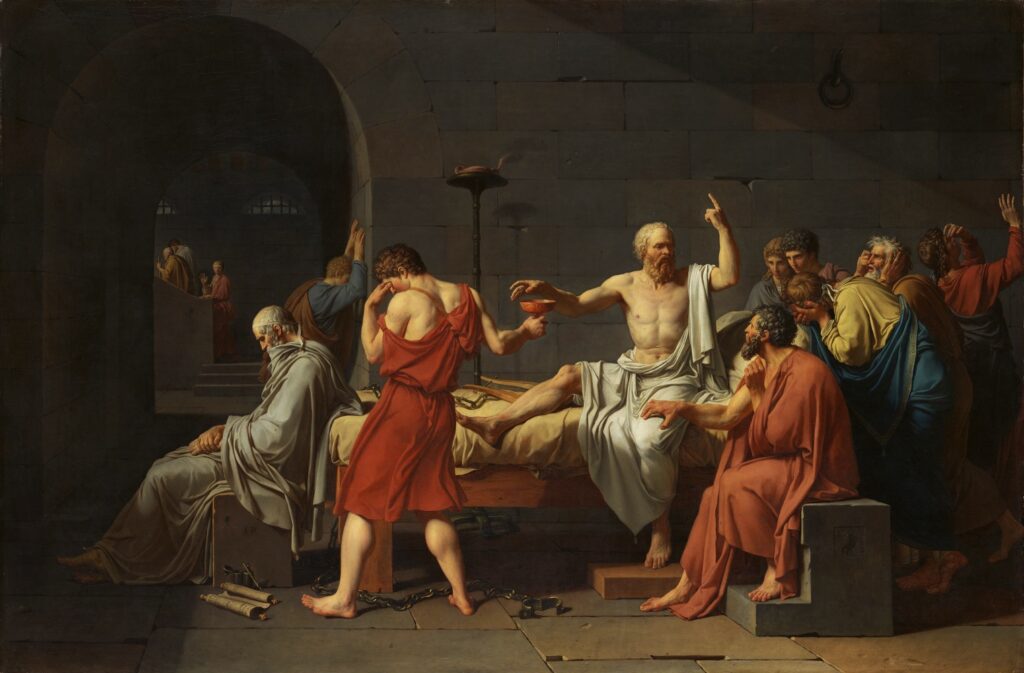
Reconstructing the life and teaching of Socrates is one of the most challenging tasks in the history of philosophy. This difficulty arises not only from the antiquity of the events, but above all from the fact that Socrates himself left no writings. Everything we know about him derives from the accounts of others, each shaped by their own aims, philosophical commitments, and personal experiences. The historical Socrates stands at the crossroads between literature and testimony, between philosophical argument and biographical memory. Understanding what is reliable in the surviving sources requires careful examination of the authors who knew Socrates, the genre in which they wrote, and the extent to which their portrayals agree or contradict one another.
The primary sources can be divided into two groups: contemporaries who personally knew Socrates and wrote about him, and slightly later authors whose depictions already reflect interpretive traditions. The first group includes Aristophanes, Xenophon, and Plato. A fourth figure, Antisthenes, wrote Socratic dialogues as well, but his works survived only in fragments and testimonies. In addition, a small number of remarks by Thucydides and Aristotle are relevant to the indirect historical framework. The second group, represented by later historians and doxographers, such as Diogenes Laertius, is valuable but less important for establishing firm historical facts.
A detailed examination of each of the main contemporary sources reveals not only the possibilities of recovering the historical Socrates, but also the limits imposed by the literary and philosophical agendas of these authors. By comparing these accounts, it becomes possible to draw careful conclusions regarding what is historically credible, what is doubtful, and what aspects of Socrates’ character belong primarily to the realm of philosophical idealization rather than strict biography.
Aristophanes: Satire as Testimony
The earliest surviving portrayal of Socrates appears not in a philosophical text but in a comedic play: Aristophanes’ Clouds, first performed in 423 BCE and revised some years later. Aristophanes was a contemporary of Socrates and lived in the same city, which gives his account a certain value as eyewitness testimony. Yet it must be remembered that Clouds is a satire and should be read accordingly.
In this play, Socrates is depicted as the head of a “Thinkery,” a peculiar institution where students learn rhetorical tricks and naturalist speculations. Aristophanes presents him suspended in the air, absorbed in cosmological research, measuring the distance of fleas’ jumps, studying clouds as deities, and teaching how to make the weaker argument defeat the stronger. This caricature lumps Socrates together with the natural philosophers and with the sophists, despite the fact that his actual teaching rejected natural speculation and opposed the sophistic use of rhetorical manipulation.
From the standpoint of strict historical truth, little in Clouds can be taken literally. However, Aristophanes’ play does provide important indirect evidence. It shows how part of the Athenian public perceived Socrates or, at least, how Aristophanes wanted them to see him. The fusion of Socrates with sophists and natural scientists indicates that his method of questioning and his unconventional intellectual habits appeared strange or dangerous to conservative audiences. Moreover, because comedy relies on exaggeration, it is likely that Socrates had gained enough prominence by the 420s to serve as a recognizable cultural figure.
The significance of Clouds lies, therefore, not in factual accuracy but in what it reveals about the hostile or suspicious attitudes toward Socratic inquiry. These impressions may have contributed to the general climate that eventually led to Socrates’ trial. From a historical perspective, Aristophanes’ testimony is valuable as evidence of social perception rather than as reliable biography.
Xenophon: The Apologist and the Moral Educator
Xenophon, soldier, historian, and student of Socrates, provides the most straightforward and apologetic account of his teacher. His principal works relevant to Socrates are Memorabilia, Apology, Symposium, and Oeconomicus. Xenophon knew Socrates personally in the last years of his life and remained deeply devoted to his memory.
Xenophon’s depiction of Socrates emphasizes four main themes: his moral uprightness, his moderation, his devotion to friends, and his practical wisdom. Xenophon presents him as a man of impeccable virtue, a benefactor to all who associated with him, and a person whose teaching focused on self-control, household management, political responsibility, and piety. The Socrates of Xenophon is a moral instructor, almost a Stoic before Stoicism, who values rational moderation above speculative inquiry.
Compared with Plato, Xenophon’s Socrates is less interested in metaphysical problems and more concerned with concrete ethical advice. He appears almost as a model gentleman, engaged in improving the character of others but avoiding deeper philosophical abstractions. Xenophon insists repeatedly that Socrates had no connection with the sophists and did not teach rhetorical tricks for financial gain. His writings are designed in part to refute the charges brought against Socrates and to demonstrate the absurdity of condemning such a virtuous man.
Despite this apologetic tendency, Xenophon’s testimony is extremely important. It offers insight into Socrates’ daily interactions, his habits, his humorous remarks, and his personal relations. The image of Socrates as a man of iron self-discipline, walking barefoot in winter, maintaining calm in moments of danger, and consistently caring for the well-being of his friends, is likely based on genuine observation. Xenophon also preserves details about Socrates’ religious views, including his belief in divine guidance and his respect for the laws of the city.
Nevertheless, Xenophon’s portrait has clear limitations. His interests lie primarily in practical ethics, and he shows little understanding of the profundity of Socratic dialectic. His Socrates rarely engages in the kind of rigorous philosophical debate found in Plato. Thus, while Xenophon’s testimony is historically valuable, it must be supplemented by other sources when considering Socrates as a philosopher rather than merely a moral exemplar.
Plato: Philosophy as Memory
Plato, Socrates’ most famous student, is unquestionably the most influential source for reconstructing Socrates’ ideas. At the same time, he is the most problematic, because his dialogues blend historical recollection with Plato’s own philosophical development. Sorting out which teachings belong to Socrates and which belong to Plato is known as the “Socratic problem.”
Plato was intimately connected with Socrates, attending his conversations, admiring his character, and being present at his death. His Apology is considered by many scholars the closest approximation to the historical Socrates, since it aims to capture the tone and substance of Socrates’ defense speech. Other early dialogues, such as Charmides, Laches, Protagoras, Euthyphro, and Crito, also seem to provide relatively authentic accounts of Socratic questioning, focusing on moral definitions, the refutation of false knowledge, and the ethical transformation of the interlocutor.
However, as Plato’s own philosophy evolved, particularly through the middle dialogues such as Phaedo, Symposium, and the Republic, the figure of Socrates becomes increasingly intertwined with Plato’s metaphysical doctrines. In these works, Socrates becomes a vehicle for the theory of Forms, the immortality of the soul, and the structure of the ideal state. While it is possible that Socrates held some religious or metaphysical beliefs, it is unlikely that he articulated them with the systematic sophistication found in Plato’s mature philosophy.
Thus, Plato’s testimony demands careful discrimination. The early dialogues likely preserve core elements of Socratic method: the demand for clear definitions, the practice of elenchus (refutation), the conviction that virtue is knowledge, and the belief that wrongdoing results from ignorance. Plato’s portrayal of Socrates’ moral character, his irony, his courage, and his philosophical mission are historically plausible. But the later, more elaborate systems reflect Plato’s own contributions.
In evaluating Plato, the historian must recognize that he is both the greatest witness and the most creative interpreter. His authority cannot be ignored, yet it cannot be accepted uncritically.
Antisthenes, Aeschines, and Other Early Socratics
Several other students of Socrates wrote Socratic dialogues, though their works survive only in fragments or reports by later authors. Among these, the most significant are Antisthenes, Aeschines of Sphettus, Euclides of Megara, and Phaedo of Elis.
Antisthenes, who later inspired the Cynic tradition, wrote dialogues portraying Socrates as an advocate of simplicity and moral independence. His interpretation emphasized asceticism and the rejection of conventional social norms. Aeschines’ surviving fragments suggest a more psychological and introspective Socrates, one who encourages self-knowledge through dialogue. Euclides and Phaedo, founders of the Megarian and Eleatic-influenced Socratic schools, interpreted Socrates in ways that foreshadowed Stoic and Neo-Platonic ideas.
Although fragmentary, these testimonies confirm that Socrates inspired diverse interpretations even among his immediate disciples. They rarely contradict the general picture provided by Xenophon and the early Plato, but they highlight different aspects of Socratic teaching. The variety itself suggests that Socrates did not leave a fixed doctrine; instead, his influence consisted in a method of inquiry and a moral attitude, which each student developed differently.
Aristotle: Retrospective Analysis
Aristotle did not know Socrates personally, but he studied Plato’s works and interacted with members of the Socratic circle. His remarks are therefore valuable as a second-generation testimony.
Aristotle credits Socrates with two major contributions: inductive reasoning and universal definitions. He also emphasizes that Socrates did not posit separate, transcendent Forms, distinguishing Socrates’ philosophical method from Plato’s metaphysics. Aristotle confirms that Socrates limited his inquiry to ethical questions and was primarily concerned with understanding virtue.
Aristotle’s retrospective testimony is useful for clarifying the difference between Socrates and Plato. It supports the conclusion that the theory of Forms belongs to Plato, not Socrates, and strengthens the reliability of treating early Platonic dialogues as more historically accurate.
Later Biographers and Doxographers
Later sources, especially Diogenes Laertius, gather anecdotes, quotations, and traditions about Socrates. Although historically distant, these compilations preserve some material from early authors whose works are now lost. Many of the stories have a legendary character—Socrates’ prophetic dreams, his love affairs, his peculiar habits—but they contribute to the cultural image of Socrates as a moral hero and philosophical saint. These later materials must be used cautiously, as they often mix fact and legend. Yet they also preserve details not found elsewhere, such as Socrates’ interactions with the Thirty Tyrants or various maxims attributed to him. When these anecdotes agree with more reliable sources, they can be cautiously accepted.
Reconciling the Sources: What Is Historically True?
By comparing all the sources, historians can draw several robust conclusions about the historical Socrates.
First, Socrates was a real historical figure of great personal charisma, known for his endurance, moderation, and imperturbable calm in the face of danger. Both Xenophon and Plato confirm this, and Aristophanes’ satire presupposes it.
Second, Socrates did not write and did not establish a school in the formal sense. Instead, he conversed with anyone willing to engage with him, in public or private settings.
Third, his primary interest lay in ethical questions, not natural philosophy. He rejected the speculative inquiries of the pre-Socratics and instead focused on the human soul, the nature of virtue, and the proper way to live.
Fourth, Socrates developed a distinctive method of inquiry that sought clear definitions and exposed contradictions in the interlocutor’s beliefs. This method, later called elenchus, is one of the most secure historical elements of his teaching.
Fifth, Socrates believed that virtue is tied to knowledge and that wrongdoing results from ignorance, though the exact formulation of this doctrine varies across the sources.
Sixth, Socrates lived a life of exemplary moral integrity and viewed philosophy as a divine mission. He believed in some form of divine guidance, expressed through his inner “sign,” and held that the gods are wise and good.
Seventh, his trial and execution were influenced not only by political tensions but also by longstanding public misunderstandings, as seen already in Clouds.
On other issues, the sources diverge or require great caution. For example, the metaphysical doctrines in Plato’s later works cannot be confidently attributed to Socrates. The more ascetic traits emphasized by Antisthenes likely reflect early Cynicism rather than Socrates himself. Xenophon’s moralizing tendency, while historically valuable, may understate Socrates’ philosophical depth.
Conclusion
The historical Socrates remains partly hidden behind the literary images constructed by Aristophanes, Xenophon, Plato, and the early Socratics. Each writer presents a different facet of the man: the eccentric intellectual mocked by a comedian, the practical moralist defended by a soldier-historian, the philosophical midwife portrayed by a devoted disciple, and the idealized sage remembered by later schools.
Yet beneath these diverse portrayals lies a consistent core: Socrates as the thinker who redirected philosophy toward the examination of human life, who placed moral integrity above social convention, who lived with ascetic simplicity and died with unshakable calm, and who believed that the pursuit of truth belongs to the very essence of the human soul. By reading all sources critically and comparatively, we can separate historical fact from literary embellishment and gain a coherent, credible image of one of the most influential figures in the history of philosophy.