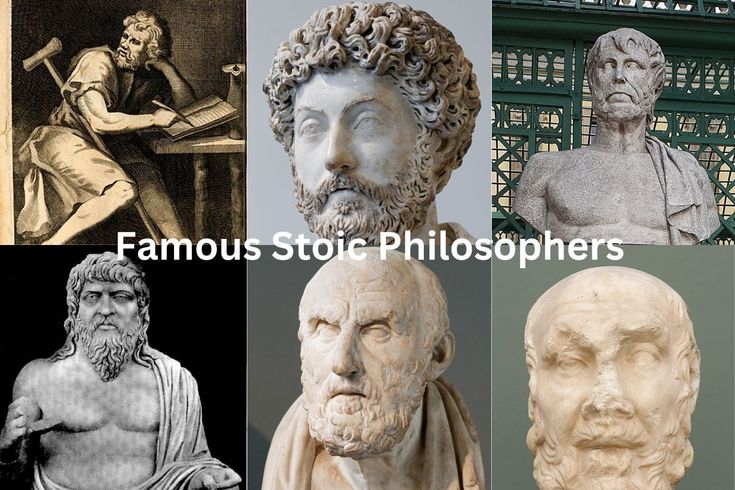
Stoicism is one of the most internally coherent and historically continuous philosophical traditions of the ancient world. Unlike schools that fragmented or disappeared after a few generations, Stoicism developed through a long succession of thinkers who shared a common ethical core while refining its theoretical foundations and practical application. The history of Stoicism is therefore best understood through the Stoic philosophers themselves, whose lives and writings embody the evolution of the tradition.
Stoicism originated as a comprehensive philosophical system encompassing logic, physics, and ethics. Its founders were concerned not only with how one should live, but with how reality is structured and how knowledge is possible. Over time, Stoicism increasingly emphasized ethics and practical discipline, especially as it entered Roman cultural and political life. This shift does not represent a decline, but an adaptation. Stoic philosophers responded to the conditions in which they lived, while preserving the essential commitments of the school.
The Greek Foundations of Stoicism
The Stoic tradition begins with Zeno of Citium, who established the school in Athens in the early third century BCE. Zeno taught that the goal of life is to live according to nature, understood as rational order. He rejected pleasure as the highest good and argued that virtue alone is sufficient for happiness. His philosophy unified ethics, logic, and physics into a single system governed by reason.
Zeno was succeeded by Cleanthes, whose contribution lay in preserving and defending Stoic doctrine. Cleanthes emphasized endurance, discipline, and reverence for cosmic reason. His writings reflect a deeply religious attitude toward the rational structure of the universe, treating acceptance of fate as an expression of wisdom rather than resignation.
The third foundational figure, Chrysippus, transformed Stoicism into a rigorous philosophical system. Chrysippus developed Stoic logic in detail, refined ethical theory, and defended Stoic physics against rival schools. Ancient sources frequently remarked that without Chrysippus, Stoicism would not have survived. His work gave the school its intellectual durability.
Other early Stoics explored alternative emphases within the tradition. Aristo of Chios minimized the importance of logic and physics, focusing almost exclusively on ethics. Herillus of Chalcedon proposed knowledge as the highest good, diverging from orthodox Stoic ethics. Persaeus applied Stoic principles to political life, demonstrating their relevance beyond abstract theory.
As Stoicism spread beyond Athens, figures such as Panaetius and Posidonius played a crucial role in adapting the school to Roman culture. They emphasized Stoicism’s compatibility with civic duty, historical reflection, and practical wisdom. Posidonius in particular expanded Stoic interests into history, geography, and natural science, reinforcing the tradition’s encyclopedic character.
Stoicism in the Roman World
Stoicism found fertile ground in Rome, where its emphasis on self mastery, duty, and inner freedom resonated with the realities of political power and instability. Roman Stoics focused less on technical logic and more on ethical formation and personal discipline, without abandoning Stoic principles.
Seneca articulated Stoicism as guidance for daily life amid wealth, power, and danger. His writings address anger, time, grief, fortune, and moral consistency. Seneca shows how Stoic ethics can be practiced within public life while maintaining inner independence.
Musonius Rufus treated philosophy as moral training rather than speculation. He emphasized simplicity, endurance, and the equal capacity of men and women for virtue. His teaching reflects Stoicism as a lived discipline aimed at character formation.
The most systematic ethical teacher of Roman Stoicism was Epictetus. His philosophy centers on the distinction between what depends on us and what does not. Epictetus presents Stoicism as a rigorous discipline of judgment, teaching that freedom consists in governing one’s responses rather than external conditions.
Stoicism reaches its most introspective expression in Marcus Aurelius, whose personal reflections reveal Stoic practice under the burden of imperial responsibility. His writings emphasize impermanence, duty, and alignment with rational order, offering a rare glimpse of Stoicism applied at the highest level of power.
Other Roman Stoics contributed to education and ethical transmission. Cornutus wrote on myth and moral interpretation, Hierocles developed Stoic ethics of social relations, and Cato the Younger embodied Stoic virtue through political resistance and personal integrity rather than philosophical writing.
Stoic Philosophers After the Roman Era
After the Roman era, Stoicism did not survive as an organized school with continuous institutional teaching. Its influence instead persisted through transmission, reinterpretation, and selective revival. Stoic philosophy became a subterranean tradition, absorbed into other intellectual frameworks and later rediscovered when historical conditions made its ethical seriousness attractive again. The history of Stoicism after Rome is therefore not one of formal succession, but of enduring philosophical influence.
Stoicism in the Medieval Period
During the medieval era, Stoicism was not practiced as an independent philosophy. Medieval thought was dominated by Christian theology, and philosophical inquiry operated largely within religious frameworks. However, Stoic ideas did not disappear. They were filtered through Christian ethics, moral psychology, and discussions of virtue, duty, and providence.
Stoic ethical concepts such as self control, endurance, moral intention, and indifference to external fortune were often absorbed into Christian moral teaching. The Stoic emphasis on inner discipline and moral integrity resonated with monastic ideals, even though Stoic cosmology and determinism were rejected or transformed.
Stoic influence in this period came primarily through Latin texts, especially moral writings rather than technical philosophy. Authors such as Seneca remained widely read, not as Stoic theorists, but as moral guides. His letters and essays were copied, studied, and cited by medieval scholars, sometimes stripped of their original philosophical context and integrated into Christian moral reflection.
Thinkers such as Boethius played a key role in transmitting Stoic ideas, particularly through reflections on fortune, fate, and inner freedom. Although not a Stoic himself, Boethius preserved Stoic ethical themes in a form compatible with medieval thought.
In the medieval period, Stoicism survived primarily as an ethical attitude rather than a philosophical system.
Stoicism in the Renaissance
The Renaissance marked the first conscious revival of Stoicism as a distinct philosophical tradition since antiquity. Humanist scholars rediscovered ancient texts, emphasized moral philosophy, and sought ethical guidance outside scholastic theology. Stoicism appealed strongly to Renaissance thinkers because of its focus on character, dignity, and self mastery.
A central figure in Renaissance Stoicism was Justus Lipsius, who explicitly attempted to reconcile Stoic ethics with Christian belief. Lipsius revived Stoic moral discipline while rejecting aspects of Stoic determinism incompatible with Christianity. His work reintroduced Stoicism as a serious ethical system for public and private life.
Other Renaissance thinkers drew heavily on Stoic ideas without adopting Stoicism wholesale. Figures such as Michel de Montaigne engaged deeply with Stoic themes, especially regarding death, habit, emotional regulation, and the limits of reason. Montaigne treated Stoicism not as doctrine, but as a practical resource for living under uncertainty.
Renaissance Stoicism emphasized moral resilience, political stability, and personal autonomy. It appealed particularly to statesmen, soldiers, and scholars navigating volatile social conditions.
Stoicism in the Modern Period
In the modern era, Stoicism ceased to function as a unified philosophical school but became a recurring influence across ethics, psychology, and political thought. Modern philosophy often rejected Stoic physics and metaphysics, yet retained Stoic insights into emotion, judgment, and moral responsibility.
Early modern thinkers engaged Stoicism critically. Baruch Spinoza developed an ethical system that, while not Stoic, echoes Stoic ideas about necessity, rational understanding, and freedom through acceptance of nature. His philosophy represents a transformation rather than continuation of Stoicism.
Enlightenment thinkers admired Stoic ethics for its emphasis on autonomy and duty. Stoic ideas influenced discussions of moral independence and rational self legislation, even when Stoicism itself was not explicitly endorsed.
In the nineteenth and twentieth centuries, Stoicism reemerged as a practical philosophy of life rather than a theoretical system. Thinkers such as Friedrich Nietzsche engaged with Stoicism polemically, criticizing its restraint while also borrowing its emphasis on self mastery and discipline.
In contemporary philosophy and psychology, Stoicism has gained renewed attention for its analysis of emotion as judgment and its focus on inner control. Modern cognitive behavioral approaches openly acknowledge Stoic influence, especially the idea that suffering arises from interpretation rather than events themselves.
Stoicism as a Continuous Influence
From the medieval period to the present, Stoicism survives not through institutional continuity but through philosophical necessity. In times of instability, moral fragmentation, or personal uncertainty, Stoic ideas return because they address enduring human problems. Stoicism after Rome is therefore best understood not as a fading tradition, but as a recurring ethical orientation that reappears whenever discipline, clarity, and inner freedom become urgent again.
Across medieval morality, Renaissance humanism, and modern ethical reflection, Stoicism continues to shape how human beings think about resilience, responsibility, and dignity under constraint.
Stoicism as a Unified Tradition
Despite differences in style, emphasis, and historical context, Stoic philosophers form a coherent lineage. They share core commitments: the rational order of the cosmos, the sufficiency of virtue for happiness, the centrality of judgment, and the possibility of inner freedom under external constraint. Stoicism is neither withdrawal from life nor submission to circumstance. It is disciplined engagement guided by reason.
What distinguishes Stoic philosophers from many other thinkers is the inseparability of theory and practice. Stoicism is not merely something to be understood, but something to be lived. The philosophers of the Stoic tradition were teachers, statesmen, slaves, emperors, and citizens who tested their ideas against real conditions of loss, power, exile, and responsibility.
Through these figures, Stoicism remains a living philosophical tradition. Its endurance is not due to rigid doctrine, but to a shared seriousness about how human beings can maintain dignity, clarity, and moral responsibility in a world that offers no guarantees.