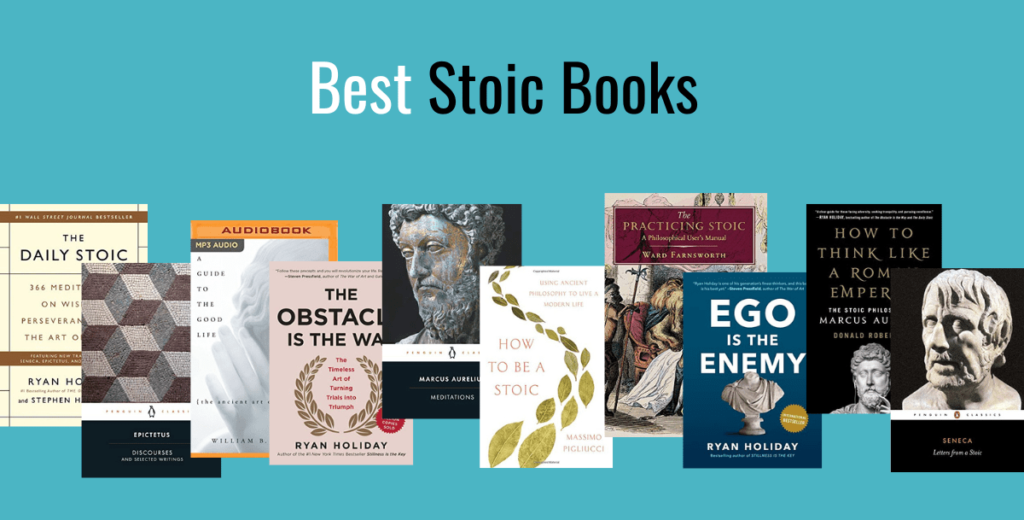
Stoicism is one of the most enduring philosophical traditions in Western thought. Originating in ancient Greece and later developing in Rome, it has remained influential for more than two millennia because it addresses permanent features of human life: suffering, uncertainty, desire, fear, duty, and mortality. Stoicism is not primarily a speculative system but a practical philosophy aimed at shaping character, judgment, and inner stability. For this reason, Stoic books continue to attract readers seeking intellectual depth as well as personal orientation.
This guide presents the major Stoicism books in a structured way, moving from the classical sources to later interpretations and modern introductions. It is intended both for readers new to Stoicism and for those who wish to deepen their understanding through serious reading.
Understanding Stoicism before reading
Before turning to specific philosophy books, it is helpful to understand what Stoicism fundamentally is. Stoicism teaches that the good life depends on living in accordance with reason and nature. External circumstances such as wealth, reputation, health, or power are not under our full control and therefore cannot be the foundation of a good life. What is within our control is judgment, intention, and moral character. Stoic ethics emphasizes virtue as the only true good and views emotional disturbances as the result of false judgments rather than unavoidable reactions.
Stoicism is traditionally divided into three interconnected areas: logic, physics, and ethics. Logic concerns correct reasoning, physics concerns the structure of reality and nature, and ethics concerns how one ought to live. While many Stoic books focus primarily on ethics, they implicitly rely on the broader Stoic worldview.
The foundational Stoic texts
The core of Stoic literature comes from a relatively small number of surviving works. Many early Stoic writings are lost, but the surviving texts are sufficient to reconstruct the practical heart of the philosophy.
Meditations
This work is perhaps the most widely read Stoic book today. Written as a private notebook by a Roman emperor, it consists of short reflections intended for self correction and moral discipline. It is not a systematic exposition of Stoicism, but a record of Stoic practice in action.
The strength of this book lies in its honesty and immediacy. It addresses anger, ambition, mortality, vanity, and the temptation to seek approval from others. The reader encounters Stoicism not as abstract doctrine, but as a daily effort to maintain clarity and self command under pressure. Because it was not written for publication, it avoids rhetorical display and speaks directly to the inner life.
This book is especially valuable for readers interested in Stoicism as a way of life rather than a theoretical system.
Letters from a Stoic
This collection of letters presents Stoic philosophy in a conversational and pedagogical form. Addressed to a younger friend, the letters explore themes such as time, death, wealth, friendship, fear, and moral progress. Seneca combines philosophical argument with literary elegance and psychological insight.
Unlike the terse style of Meditations, these letters are expansive and reflective. They often acknowledge human weakness while insisting on moral aspiration. Seneca does not present himself as morally perfected, which makes his writing particularly accessible. He treats philosophy as a lifelong process rather than a finished state.
These letters are ideal for readers who want thoughtful exposition combined with practical guidance.
Enchiridion
This short manual distills Stoic ethics into concise rules and reminders. It was compiled by a student of Epictetus and reflects his teaching style. The central theme is the distinction between what is within our control and what is not.
The Enchiridion is demanding in its clarity. It allows little room for self deception. Emotional disturbance is treated as a failure of judgment, not as an external misfortune. This makes the book challenging but also clarifying. It functions well as a daily reference rather than a text to be read once and set aside.
For readers seeking disciplined ethical instruction, this book remains unmatched.
Discourses
This work records longer discussions in which Epictetus addresses students directly. It expands on the principles found in the Enchiridion and places them within real life situations. Topics include freedom, responsibility, social roles, and the misuse of philosophy.
The Discourses reveal Stoicism as a demanding moral practice rather than a comforting worldview. Epictetus frequently confronts his students with their inconsistencies and excuses. This makes the book particularly valuable for readers who want to understand the rigor of Stoic ethical training.
On the Shortness of Life
This essay is one of the most concise and penetrating works in the Stoic tradition. Its central claim is simple yet unsettling: life is not short by nature, but is made short by misuse. Seneca argues that most people squander their time through distraction, ambition, social obligation, and the pursuit of status, while convincing themselves that they are merely busy or responsible. Time, unlike wealth or possessions, cannot be recovered once lost, yet it is treated with the least care.
What gives this text lasting relevance is its psychological accuracy. Seneca identifies patterns that feel distinctly modern: constant activity without direction, absorption in trivial concerns, and postponement of meaningful reflection until an undefined future. He observes that people guard their property fiercely but allow others to claim their time without resistance. In Stoic terms, this represents a failure to recognize what truly belongs to us.
The essay is not pessimistic. Its tone is corrective rather than accusatory. Seneca insists that a well lived life is available at any moment, provided one reclaims attention and aligns time with what is genuinely valuable. Philosophy, for him, is the practice that teaches how to inhabit time consciously rather than drift through it. This makes the essay especially relevant in an age of perpetual distraction and digital fragmentation.
On Anger
This work is one of the most systematic Stoic analyses of a single emotion. Seneca treats anger not as a natural or unavoidable reaction, but as a cognitive error that escalates into moral failure when left unchecked. Unlike approaches that moralize anger or glorify it as righteous force, Seneca examines it as a destabilizing passion that damages judgment, relationships, and political life.
The treatise is structured carefully. Seneca begins by defining anger, then explains how it arises, why it feels persuasive, and how it can be prevented or corrected. He emphasizes that anger always involves assent to a false belief, typically the belief that one has been wronged in a way that justifies retaliation. By identifying this judgment, Stoicism offers a path toward intervention before anger becomes destructive.
Importantly, Seneca does not advocate emotional numbness. He distinguishes between rational response and irrational escalation. The Stoic goal is not passivity, but clarity. Justice and firmness are compatible with calm reasoning, whereas anger undermines both. This makes the text especially relevant to modern discussions about outrage, moral indignation, and emotional polarization. It remains one of the clearest examples of Stoic moral psychology in action.
The Complete Works
Reading Seneca’s collected writings offers a panoramic view of Roman Stoicism in practice. Unlike single essays, the complete corpus reveals the internal tensions, adaptations, and contradictions that arise when philosophical ideals confront political power, wealth, and social responsibility. Seneca was not a detached teacher but an active participant in public life, which gives his writings a distinctive urgency.
Across essays, letters, and dialogues, recurring themes emerge: the instability of fortune, the misuse of wealth, the fear of death, the moral risks of ambition, and the difficulty of living consistently within corrupt systems. Seneca repeatedly acknowledges the gap between philosophical ideals and lived reality, including his own failures to meet Stoic standards. This self awareness gives his work credibility rather than weakness.
For readers, the value of the complete works lies in seeing Stoicism as an ongoing struggle rather than a perfected doctrine. Seneca presents philosophy as a discipline for those already entangled in social obligations, not as an escape from them. His writings demonstrate how Stoicism adapts to real conditions without abandoning its ethical core, making the collection essential for anyone seeking a serious understanding of Stoic ethics in public and private life.
Fragments
The fragmentary sources of early Stoicism preserve the foundations upon which later Stoic ethics were built. Although the original works of figures such as Zeno of Citium and Chrysippus are largely lost, their ideas survive through quotations, summaries, and critiques by later authors. These fragments are indispensable for understanding Stoicism as a complete philosophical system rather than only a practical ethics.
Early Stoicism placed strong emphasis on logic and physics alongside ethics. Logic addressed how correct reasoning protects the mind from error, while physics described a rational, ordered universe governed by necessity and causation. Ethics, in this framework, depends on understanding both how the world operates and how human judgment functions within it. Without this background, Stoic ethical claims can appear arbitrary or overly rigid.
These fragment collections are demanding. They are technical, often abstract, and less immediately applicable than later Roman texts. However, for readers interested in the intellectual architecture of Stoicism, they provide essential depth. They reveal that Stoic acceptance of fate, emotional discipline, and moral responsibility rest on a coherent worldview rather than mere personal resilience.
Early Stoicism and fragmentary sources
The founders of Stoicism, such as Zeno of Citium, Cleanthes, and Chrysippus, left few complete works that survive today. Knowledge of early Stoicism comes largely from later authors and fragments. While these sources are less accessible, they are important for understanding Stoicism as a complete philosophical system.
Scholarly collections of fragments and testimonies are useful for readers interested in Stoic physics and logic. These areas explain why Stoicism places such emphasis on rational acceptance of fate and natural order. However, these texts are best approached after familiarity with the practical writings.
Roman Stoicism and social life
Roman Stoicism developed in a context of political power, social hierarchy, and moral compromise. This gives its literature a distinctive tone. Roman Stoics were often deeply involved in public life, which forced them to confront the tension between moral ideals and political reality.
Stoic books from this period address questions of duty, obedience, exile, and injustice. They show how Stoicism functioned not as withdrawal from society, but as a framework for engagement without inner corruption. This aspect makes Roman Stoicism particularly relevant to modern readers navigating complex social systems.
Modern books on Stoicism
In recent decades, Stoicism has experienced a revival, particularly in popular philosophy and self cultivation literature. Modern Stoicism books vary widely in quality. Some offer thoughtful reinterpretations grounded in the original texts, while others simplify Stoicism into motivational slogans.
The most serious modern works emphasize fidelity to classical sources while translating Stoic ideas into contemporary language. They often address modern problems such as stress, consumerism, career anxiety, and social media without reducing Stoicism to mere productivity advice.
Readers should approach modern Stoicism books critically and use them as supplements rather than replacements for the classical texts.
How to read Stoic books effectively
Stoicism is not best approached as a one time intellectual exercise. Its books are meant to be read slowly, revisited, and applied. Short passages often contain ideas that require reflection over time.
Keeping a notebook while reading can help clarify how Stoic principles apply to one’s own judgments and habits. Many Stoic texts were originally intended as exercises rather than informational material. Reading them in this spirit preserves their original purpose.
It is also useful to read multiple Stoic authors rather than relying on a single voice. Differences in tone and emphasis reveal the flexibility of Stoicism within a shared ethical framework.
Stoicism and misconceptions
A common misconception is that Stoicism promotes emotional suppression or indifference to life. Stoic books do not argue against feeling, but against being ruled by irrational judgments. They emphasize appropriate emotional responses grounded in reason.
Another misunderstanding is that Stoicism encourages passivity. In fact, Stoic ethics emphasizes action in accordance with one’s role and capacity, combined with acceptance of outcomes beyond control. This balance between effort and acceptance is central to Stoic practice.
Careful reading of primary Stoic texts dispels these misconceptions more effectively than secondary summaries.
Why books on Stoicism remain relevant
Stoicism persists because it addresses structural features of human existence that do not change with technology or culture. Uncertainty, loss, ambition, and fear remain constant. Stoic books offer a coherent framework for facing these conditions without illusion.
They do not promise happiness as pleasure or success, but as inner coherence and moral clarity. For readers willing to engage seriously, Stoicism offers not escape from reality, but a disciplined way of inhabiting it.
Conclusion
Books on Stoicism form a compact yet profound philosophical tradition centered on ethical seriousness, rational judgment, and inner freedom. From the reflective notes of a Roman emperor to the uncompromising instruction of a former slave, these works demonstrate that philosophy can be both intellectually rigorous and practically transformative.
Reading Stoicism books is not about adopting an identity or following a trend. It is about learning to distinguish what truly matters from what merely demands attention. For those seeking a philosophy that respects human limitation while insisting on moral responsibility, Stoicism remains one of the most demanding and rewarding paths available.