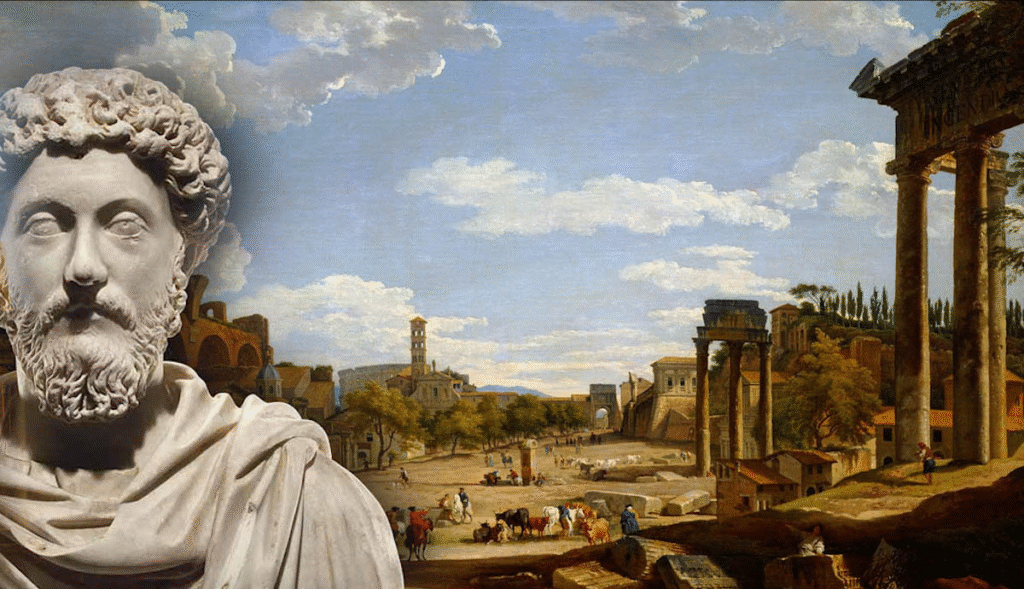
When Rome conquered Greece, it also inherited Greek philosophy. Among the many schools that entered Roman thought, none proved more enduring than Stoicism. What began as a Greek doctrine of reason and nature became, in Roman hands, a guide to conduct, politics, and personal virtue. The Stoics of Rome transformed philosophy from abstract speculation into a practical art of living. Their influence reached senators and emperors, soldiers and slaves, and their moral discipline left a mark that shaped Western ethics for centuries.
From Greece to Rome
Stoicism was founded in Athens around 300 BCE by Zeno of Citium, a philosopher from Cyprus who taught in a painted colonnade called the Stoa Poikile, from which the school took its name. Zeno and his successors Cleanthes and Chrysippus developed a system based on logic, physics, and ethics. They taught that the universe is governed by divine reason, or logos, and that human beings, as rational creatures, should live in harmony with this order. Virtue, they said, is the only true good. External things such as wealth, health, or reputation are indifferent in comparison with the moral state of the soul.
By the second century BCE, Stoicism had reached the Roman Republic. The Romans were practical people who valued duty and discipline, and they found in Stoicism a philosophy that spoke their language. It taught self-control, endurance, and responsibility to the community. Roman statesmen saw in it a moral foundation for civic life, while individuals found in it a source of strength amid fortune’s changes.
Panaetius and Posidonius
The first major bridge between Greek and Roman Stoicism was Panaetius of Rhodes. Living in the second century BCE, he moved in the circles of the Roman elite, particularly that of Scipio Aemilianus, the conqueror of Carthage. Panaetius softened the harsher features of early Stoicism and adapted it to Roman sensibilities. He emphasized moral duty and moderation rather than rigid asceticism. His influence helped to make Stoicism the preferred philosophy of the educated Roman aristocracy.
His successor, Posidonius of Apamea, extended Stoicism into cosmology and psychology. He blended Stoic ideas with Platonic and Aristotelian elements and influenced both Cicero and Seneca. Posidonius’s view of the universe as a living organism infused by divine reason inspired a sense of cosmic piety. The Stoic sage, in his teaching, was not detached from the world but an active participant in its rational order.
Cicero and the Roman Ethos
Although Cicero was not a Stoic, he played a vital role in transmitting Stoic thought to the Roman world. His treatise On Duties drew heavily from Panaetius. Cicero admired the Stoic idea that moral integrity is the foundation of public life. In his view, the good citizen must act not for personal advantage but for the common good. He also accepted the Stoic conviction that virtue is in harmony with nature and that right reason is the same for all rational beings.
Through Cicero, Stoicism entered the Roman conception of law and justice. The Stoic belief in a universal law of reason became the philosophical basis for the Roman idea of ius naturale, or natural law, which later influenced Christian theology and modern political thought.
Stoicism as a Roman Ideal
By the early Empire, Stoicism had become more than a philosophy; it was a moral identity. It appealed to those who sought stability in an age of political uncertainty. The Stoic ideal of inner freedom spoke to people living under autocratic rulers. Even if external freedom was lost, one could remain free in mind by mastering desire and fear.
Stoicism also suited the Roman temperament. The Roman admired self-discipline, duty, and endurance. Stoic ethics presented these virtues as expressions of reason rather than mere habits. The philosopher Epictetus, once a slave, and the emperor Marcus Aurelius, master of the world, shared the same conviction that virtue depends only on the self. In this way, Stoicism transcended class and status.
Seneca: Philosophy and Power
Lucius Annaeus Seneca, born in Corduba around 4 BCE, became the most famous Roman Stoic of the first century. A writer, statesman, and tutor to Emperor Nero, Seneca lived at the heart of imperial politics. His life was marked by tension between philosophy and power. He accumulated wealth and influence yet preached simplicity and virtue. His writings reflect this struggle between the demands of public life and the pursuit of inner peace.
In his Letters to Lucilius, On Anger, On the Shortness of Life, and other essays, Seneca presents Stoicism as a practical guide to living well. He teaches that time is our most valuable possession, that external fortune is beyond control, and that true happiness lies in self-command. Philosophy, for Seneca, is medicine for the soul. Its purpose is to free us from passions—fear, envy, greed—that disturb the mind.
Seneca emphasizes the unity of humanity. All people share reason, which makes them citizens of a single moral community. This idea had profound ethical implications in a world built on hierarchy. He urged kindness toward slaves and compassion toward others, arguing that virtue requires justice and goodwill.
Despite his moral teaching, Seneca’s political career ended tragically. Accused of conspiracy by Nero, he was ordered to take his own life in 65 CE. His calm acceptance of death became a legendary example of Stoic courage.
Epictetus: The Philosopher of Inner Freedom
Epictetus was born a slave in Hierapolis in Asia Minor, probably around 55 CE. He was brought to Rome, where he studied philosophy while serving a master who allowed him to attend lectures by Stoic teachers. After gaining his freedom, he taught philosophy first in Rome and later in Nicopolis, in Greece. His teachings were recorded by his student Arrian in the Discourses and the Enchiridion, or Manual.
Epictetus represents the purest expression of Stoic ethics. He distinguished sharply between what is within our control and what is not. Our opinions, desires, and actions are our own; wealth, reputation, and the actions of others are not. Freedom consists in focusing only on what depends on us and accepting everything else as the will of nature.
He taught that suffering arises from mistaken judgments. People are not disturbed by events themselves but by their interpretations of them. To live according to reason is to align one’s judgments with reality. This insight gave Stoicism a psychological depth that has kept it relevant to modern readers.
Epictetus’s philosophy was austere but not pessimistic. He believed that the world is governed by divine providence and that every event has a place in the order of things. The Stoic must therefore live with gratitude and courage, trusting that even misfortune serves a purpose. His simple and direct teaching influenced not only ancient audiences but later Christian thinkers and modern moral philosophy.
Musonius Rufus: The Practical Stoic
Another important Roman Stoic was Gaius Musonius Rufus, a teacher active during the reigns of Nero and Vespasian. He was known for combining moral rigor with practical advice. Musonius believed that philosophy should guide everyday conduct, from diet and clothing to family life. He advocated education for women and taught that virtue is the same for both sexes. His emphasis on moderation and self-control made Stoicism accessible to ordinary people.
Musonius also stressed that philosophy is not merely words but practice. To study Stoicism is to train the mind as athletes train the body. His idea of philosophy as exercise influenced later traditions of moral discipline.
Marcus Aurelius: The Emperor Philosopher
The culmination of Roman Stoicism came with Marcus Aurelius, emperor from 161 to 180 CE. Trained in philosophy from youth, Marcus ruled an empire beset by wars and plague. Amid these trials, he turned inward to the teachings of reason. His Meditations, written in Greek during military campaigns, are a record of personal reflection rather than a systematic treatise.
In these private notes, Marcus seeks to live according to Stoic principles while carrying the burden of imperial duty. He reminds himself to accept each event as part of nature’s order, to act justly without anger, and to remember the brevity of life. He writes of the transience of fame and power, observing that all human things soon pass away. What matters is to do one’s duty in the present moment.
Marcus’s Stoicism is deeply humane. He believes that all people share a common reason and are part of one cosmic city. To harm another is to injure oneself. The ruler, therefore, must govern not by fear but by rational justice. His reflections show the moral seriousness of a man who sought to reconcile absolute power with philosophical humility.
The Stoic View of Nature and Providence
At the heart of Roman Stoicism lies a distinctive view of the universe. The Stoics taught that the cosmos is a living, rational whole pervaded by divine reason. Everything happens according to the necessity of nature. This doctrine of providence does not deny freedom, because true freedom consists in consenting to the order of things. The wise person wills what the gods will.
Fate, in Stoic thought, is not blind determinism but rational necessity. Events unfold according to cause and effect, guided by the divine logos. Human beings, as parts of this whole, fulfill their purpose by acting in accordance with reason. Virtue, therefore, is harmony with nature. To live contrary to reason is to rebel against the structure of reality itself.
This cosmic vision gave Stoicism both moral strength and serenity. It allowed individuals to endure misfortune without bitterness and to meet death without fear. The Stoic does not control external events but controls how to meet them.
Stoicism and Roman Religion
Although Stoicism was a philosophy, it also functioned as a form of religion for many Romans. Its belief in divine reason provided a moral and spiritual framework without dependence on myth. Stoics participated in civic rituals, interpreting the gods as expressions of the rational order rather than as personal deities. This flexibility made Stoicism compatible with traditional Roman piety.
At the same time, Stoicism influenced the moral tone of Roman religion. The emphasis on virtue, duty, and universal reason elevated the idea of moral responsibility before the divine order. Later Christian writers such as Tertullian and Lactantius admired the Stoics for their ethical seriousness, even as they rejected their cosmology. The Stoic conception of natural law and conscience paved the way for Christian moral theology.
Stoicism and Roman Society
In Roman society, Stoicism offered a moral code that appealed to people of every class. For senators and governors, it justified service and sacrifice. For soldiers, it gave endurance. For slaves and the poor, it offered inner freedom. The Stoic doctrine that all humans share reason undermined rigid social hierarchies. Epictetus, once a slave, could stand as a moral equal to any emperor.
Stoicism also shaped Roman jurisprudence and civic duty. The idea that law is grounded in universal reason influenced the development of Roman legal theory. The concept of the citizen as part of a rational community transcending local customs anticipated later ideas of human rights.
Decline and Legacy
By the third century, Stoicism began to decline as a distinct school. The rise of Neoplatonism and Christianity changed the intellectual landscape. Yet Stoic ideas survived within both. Christian asceticism inherited the Stoic virtues of self-discipline and acceptance. The Neoplatonists absorbed Stoic cosmology and ethics into their system.
In the Renaissance, Stoicism was revived by humanists who admired its moral clarity. In the seventeenth century, thinkers such as Descartes and Spinoza drew upon Stoic ideas of reason and necessity. In the modern world, Stoic ethics have regained popularity as a philosophy of resilience. The contemporary practice of “modern Stoicism,” based on writings of Seneca, Epictetus, and Marcus Aurelius, adapts ancient wisdom to the challenges of modern life.
The Spirit of Roman Stoicism
Roman Stoicism differs from its Greek origin in tone and purpose. The Greek Stoics built a system of metaphysics and logic. The Romans turned it into a guide for moral conduct. They were less interested in abstract theory than in the art of living with dignity. Stoicism became a civic virtue, a personal religion, and a philosophy of duty.
Its central message is that happiness depends on character, not circumstance. Wealth, power, and pleasure are fleeting; virtue alone is secure. The Stoic learns to desire nothing contrary to reason and to accept all events as part of nature’s plan. Such discipline demands courage and humility. It requires one to live each day as if it were a complete life.
The enduring appeal of Roman Stoicism lies in its balance between reason and emotion, action and reflection. It does not promise escape from the world but peace within it. In an empire of vast complexity, it taught simplicity. Amid luxury and violence, it called for self-restraint. In a time of uncertainty, it offered the steady calm of inner freedom.
Conclusion
The Stoic philosophers of Rome transformed a Greek school into a universal moral tradition. From Panaetius and Posidonius to Seneca, Epictetus, and Marcus Aurelius, they gave philosophy a human face. They taught that virtue is within everyone’s reach and that the wise person remains free even in chains.
Their vision of life in harmony with reason and nature became one of the cornerstones of Western thought. Stoicism shaped Roman ideals of citizenship and justice, influenced Christian ethics, and continues to inspire those who seek strength in adversity. It speaks to every age that confronts change and loss, reminding us that while we cannot govern fortune, we can govern ourselves.
In the words of the Roman Stoics, reason is our common inheritance, virtue our highest good, and serenity the reward of a mind at peace with itself. The legacy of Stoicism endures wherever people strive to live wisely, act justly, and accept the world as it is while working to make it better.