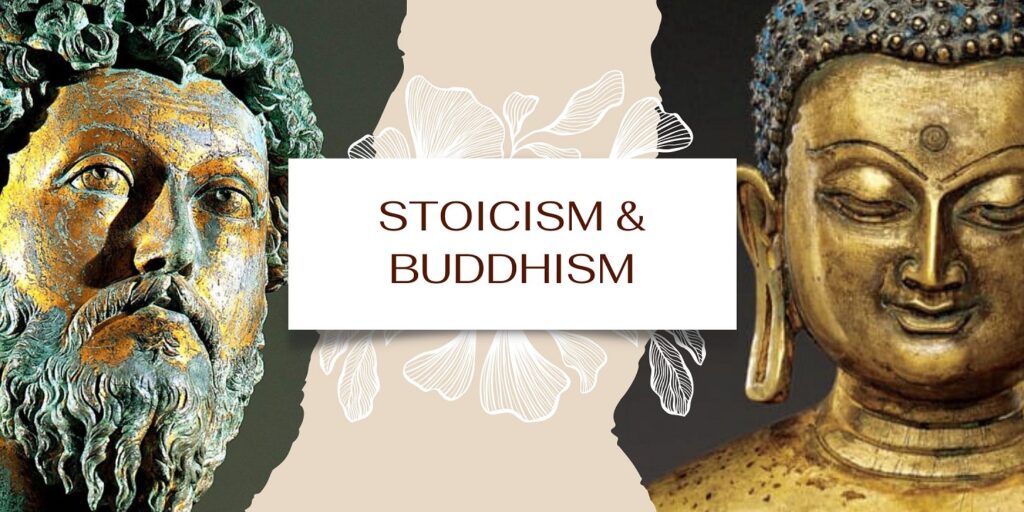
Across cultures and centuries, human beings have grappled with the same fundamental questions: how to live well, how to endure suffering, and how to find peace in a world that rarely aligns with our desires. Two philosophical traditions stand out as remarkably similar in their responses to these questions: Stoicism, emerging in ancient Greece and Rome, and Buddhism, originating in ancient India. Though separated by geography and historical context, both systems converge on a shared vision of inner freedom, emotional discipline, and a life aligned with reality.
The idea that Stoicism can be understood as a Western counterpart to Buddhism is not merely a superficial comparison. When examined closely, the parallels between these traditions are striking, both in their ethical goals and their practical methods. Yet the differences are equally revealing, highlighting distinct cultural assumptions about the self, the world, and ultimate truth. Exploring both similarities and differences provides a deeper understanding of what each tradition offers.
Origins and Historical Context
Stoicism began in Athens around the 3rd century BCE, founded by Zeno of Citium. It later flourished in Rome through thinkers such as Seneca, Epictetus, and Marcus Aurelius. Stoicism developed within a philosophical environment concerned with logic, ethics, and natural law. It was shaped by the Greek emphasis on rationality and the Roman concern with practical life.
Buddhism emerged slightly earlier, around the 5th century BCE, through the teachings of Siddhartha Gautama, known as the Buddha. It arose in a spiritual and religious context that already included ideas such as karma, rebirth, and liberation from the cycle of suffering. Unlike Stoicism, which remained within the sphere of philosophy, Buddhism developed into a comprehensive spiritual tradition with rituals, monastic communities, and metaphysical doctrines.
Despite these differences, both traditions responded to a similar human condition: the instability of life, the inevitability of suffering, and the need for a stable inner foundation.
The Problem of Suffering
At the heart of Buddhism lies the recognition of suffering, articulated in the Four Noble Truths. Life, as ordinarily lived, is characterized by dissatisfaction, impermanence, and unease. This suffering arises from attachment, desire, and ignorance. Liberation comes through understanding this condition and following the Eightfold Path.
Stoicism approaches suffering from a different angle but arrives at a similar conclusion. For the Stoics, suffering arises not from external events themselves but from our judgments about them. External things such as wealth, status, and even health are considered indifferent. What truly matters is how we respond to them. Disturbance is created by false beliefs about what is good or bad.
Both traditions identify a common source of human distress: a mismatch between reality and our expectations. In Buddhism, this mismatch is driven by craving. In Stoicism, it is driven by mistaken judgments. In both cases, the solution lies in transforming the mind rather than the external world.
Control and Acceptance
One of the most well known Stoic ideas is the distinction between what is within our control and what is not. Our thoughts, intentions, and actions are within our control. External events, other people, and outcomes are not. Wisdom lies in focusing only on what can be controlled and accepting everything else.
Buddhism expresses a similar principle through the idea of non attachment. Clinging to outcomes, identities, or possessions leads to suffering because everything is impermanent. By letting go of attachment, one can experience a deeper form of peace that is not dependent on circumstances.
In both systems, acceptance is not passive resignation. It is an active alignment with reality. The Stoic accepts fate as part of a rational and ordered universe. The Buddhist accepts impermanence as a fundamental characteristic of existence. In both cases, acceptance leads to freedom from emotional turbulence.
The Nature of the Self
A major point of divergence between Stoicism and Buddhism lies in their understanding of the self.
Stoicism assumes a stable, rational self that can develop virtue and align itself with reason. The self is not rejected but refined. The goal is to become a wise and virtuous individual who lives in accordance with nature and reason.
Buddhism, especially in its classical formulations, denies the existence of a permanent self. The doctrine of non self teaches that what we call the self is merely a collection of changing processes. Clinging to the idea of a fixed identity is itself a source of suffering.
This difference has practical implications. Stoicism encourages the cultivation of character and identity grounded in virtue. Buddhism encourages the dissolution of attachment to identity altogether. Yet both approaches aim at the same result: freedom from ego driven suffering.
Emotions and Mental Discipline
Both traditions place strong emphasis on mastering the mind.
Stoicism teaches that destructive emotions such as anger, fear, and excessive desire arise from incorrect judgments. By examining and correcting these judgments, one can achieve a state of tranquility. The ideal Stoic is not emotionless but free from irrational passions.
Buddhism similarly identifies emotions such as greed, hatred, and delusion as sources of suffering. Through practices such as meditation and mindfulness, one learns to observe these states without being controlled by them. Over time, this leads to equanimity and clarity.
The techniques differ, but the goal is similar: a stable and disciplined mind that is not easily disturbed. Stoicism often relies on rational reflection, journaling, and mental exercises. Buddhism relies more heavily on meditation and direct awareness. Both methods aim to reshape habitual patterns of thought.
Living in the Present
A shared theme in both traditions is the importance of the present moment.
Stoics frequently remind themselves that the past is gone and the future is uncertain. The only reality is the present, and it is here that virtue must be practiced. Marcus Aurelius repeatedly emphasizes the value of focusing on the present task and doing it well.
Buddhism places even greater emphasis on present awareness. Mindfulness, one of its central practices, involves paying attention to the present moment without judgment. By fully inhabiting the present, one becomes free from the anxieties tied to past and future.
In both cases, attention to the present reduces unnecessary suffering and enhances clarity. It shifts the focus from imagined scenarios to actual experience.
Ethics and Compassion
Both Stoicism and Buddhism promote ethical living, though their foundations differ.
Stoic ethics are grounded in reason and the idea of living in accordance with nature. Humans are social beings, and therefore virtue includes justice, fairness, and concern for others. The Stoic ideal is a person who contributes to the common good while maintaining inner independence.
Buddhist ethics are grounded in compassion and the recognition of shared suffering. Since all beings experience suffering, there is a moral imperative to reduce harm and cultivate kindness. The principle of compassion extends beyond human society to all living beings.
Despite different justifications, both traditions encourage similar behaviors: honesty, self restraint, and care for others. Both see ethical conduct as essential to inner peace.
Attitude Toward Death
Both Stoicism and Buddhism confront death directly and without avoidance.
Stoics view death as a natural and inevitable part of life. Since it is beyond our control, it should not be feared. Reflecting on death can help clarify priorities and reduce attachment to trivial concerns.
Buddhism also treats death as an integral aspect of existence. Meditation on death is used to deepen understanding of impermanence and to motivate spiritual practice. In some forms of Buddhism, death is part of a larger cycle of rebirth, while in others it is understood more existentially.
In both traditions, acceptance of death reduces fear and enhances appreciation of life. It encourages a focus on what truly matters.
Practical Exercises
One of the most compelling similarities between Stoicism and Buddhism lies in their emphasis on practice.
Stoicism offers a range of mental exercises. These include negative visualization, where one imagines losing what one values to reduce attachment, and daily reflection, where one reviews actions and thoughts. These practices are designed to strengthen resilience and clarity.
Buddhism offers structured practices such as meditation, breathing exercises, and ethical precepts. These practices are often more systematic and are supported by a long tradition of instruction and community.
Both traditions understand that insight alone is not enough. Transformation requires consistent practice. Philosophy, in this sense, is not theoretical but lived.
Differences in Metaphysics
While the practical teachings of Stoicism and Buddhism often converge, their underlying metaphysical frameworks differ significantly.
Stoicism is rooted in a belief in a rational and ordered universe. The cosmos is governed by logos, a principle of reason that permeates everything. Fate is not random but structured and meaningful.
Buddhism does not posit a universal rational order in the same way. Instead, it emphasizes dependent origination, the idea that all phenomena arise in relation to conditions. There is no overarching rational plan, only interconnected processes.
These differences shape how each tradition interprets reality. Stoicism sees alignment with reason as alignment with the structure of the universe. Buddhism sees insight into impermanence and interdependence as the path to liberation.
Individual and Community
Stoicism tends to emphasize the individual’s inner life. While social responsibility is important, the focus remains on personal virtue and self mastery.
Buddhism places greater emphasis on community, especially in its monastic forms. The sangha, or community of practitioners, plays a crucial role in supporting the path.
This difference reflects broader cultural contexts. Greek and Roman philosophy often centered on individual excellence. Indian traditions often integrated individual practice within communal and spiritual frameworks.
Convergence in Modern Interpretation
In contemporary discussions, Stoicism and Buddhism are often brought together as practical guides for modern life. Many people find that combining elements from both traditions enhances their effectiveness.
Stoic techniques of rational analysis can complement Buddhist mindfulness practices. The Stoic focus on duty and action can balance the Buddhist emphasis on observation and detachment. Together, they form a comprehensive approach to mental clarity and resilience.
Modern psychology has also recognized the value of both traditions. Cognitive behavioral therapy, for example, shares similarities with Stoic ideas about challenging beliefs. Mindfulness based therapies draw directly from Buddhist practices.
Conclusion
Stoicism and Buddhism, though born in different parts of the world, offer remarkably similar answers to the challenges of human existence. Both recognize that suffering is rooted in the mind rather than in external conditions. Both emphasize discipline, awareness, and alignment with reality. Both offer practical methods for achieving inner peace.
At the same time, their differences provide valuable perspectives. Stoicism affirms the role of reason and the development of a virtuous self. Buddhism questions the very notion of self and points toward a more radical form of freedom.
Understanding Stoicism as a Western version of Buddhism is a useful starting point, but it is not the final word. Each tradition stands on its own, shaped by its history and assumptions. Together, they reveal a shared human effort to find stability in an unstable world, and to live with clarity, strength, and peace.