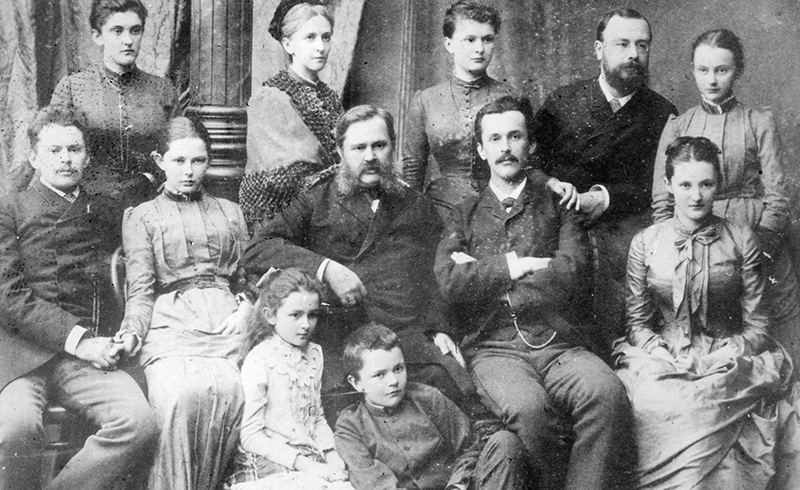
The Trubetskoy family occupies a distinctive place in Russian history. It is one of the oldest princely houses, carrying a lineage that reaches back to the medieval rulers of Lithuania and the early centuries of Eastern Christianity. Over time the family produced military leaders, statesmen, diplomats, scholars, and some of the most influential philosophers of the Russian Silver Age. The philosophical tradition within the family became especially prominent in the nineteenth and early twentieth centuries when Sergei Nikolaevich Trubetskoy and Evgeny Nikolaevich Trubetskoy created an original Russian synthesis of religious thought, idealism, and cultural philosophy. Their work shaped the direction of Russian metaphysics, the development of Moscow spiritual academic scholarship, and the broader conversation on the relationship between reason, faith, and the historical destiny of cultures.
This article provides a historical overview of the noble family, outlines the lives of its major members, and presents a detailed exploration of the philosophical tradition that emerged within this house. Together these elements reveal how a centuries old princely line came to stand at the center of Russian intellectual life.
Origins of the Trubetskoy Family
The Trubetskoy family traces its ancestry to the princes of the Grand Duchy of Lithuania. According to genealogical tradition, the progenitor was Prince Gediminas or one of his close descendants, from whom many Lithuanian and Ruthenian princely houses originate. By the fourteenth and fifteenth centuries the family possessed wide lands in the region of Trubetsk and Bryansk. The area was strategically located between Muscovy, Lithuania, and the lands of the Ruthenian principalities. As political alliances shifted, members of the family sometimes served Lithuanian rulers and at other times allied themselves with Muscovite princes.
The turning point came in the fifteenth century when Prince Yuri Patrikeevich, a representative of the extended Gediminid line, shifted allegiance to Moscow. From this moment the Trubetskoy family became integrated into the Muscovite nobility while preserving its princely status. Its members later served as boyars, military commanders, regional governors, and diplomats during the formative centuries of the Russian state.
During the seventeenth and eighteenth centuries the family continued to play an important role in court and military affairs. Several members became associates of Peter the Great and his successors. Over time the family name came to signify not only noble rank but also participation in state administration, military leadership, and cultural patronage.
By the nineteenth century internal differentiation within the extended family produced multiple branches. Some followed military service, others diplomatic work, and a few entered academic life. It was from this intellectual branch that the major philosophers emerged.
Major Historical Figures Before the Philosophers
Before discussing the philosophical members of the family it is helpful to outline several notable figures who shaped the family reputation and provided the cultural environment that later allowed a scholarly tradition to grow.
Ivan Yurievich Trubetskoy was a seventeenth century military commander who served during the turbulent period of the Time of Troubles. He played a key role in campaigns along the southern frontier and took part in efforts to restore order and stabilize central control.
Nikita Yurievich Trubetskoy, a statesman of the early eighteenth century, served in the administration of Peter the Great. His career reflects the integration of ancient noble families into the modernizing structures of the Russian Empire.
Dmitry Timofeyevich Trubetskoy was an influential figure in the early seventeenth century. He became one of the leaders of the movement that expelled Polish forces from Moscow and helped end the Time of Troubles. Because of this he is remembered in chronicles as a restorer of the Russian state.
Nikolay Ivanovich Trubetskoy, an eighteenth century general and governor, also deserves mention. His service in the imperial army and his administrative work prepared the path that allowed later generations of the family to receive high level education and cultivate scholarly interests.
These figures represent only a few of the many members who served the Russian state across centuries. Their contributions created an atmosphere of duty, learning, and public service that influenced the upbringing of the nineteenth century intellectual generation.
The Emergence of the Philosophical Branch
The philosophical tradition within the Trubetskoy family emerged primarily in the late nineteenth century. It was shaped by the intellectual currents of the time, including the revival of patristic studies, the influence of German idealism, and the new interest in cultural history, comparative religion, and moral philosophy.
The two most important philosophical representatives of the family were:
- Sergei Nikolaevich Trubetskoy (1862–1905)
- Evgeny Nikolaevich Trubetskoy (1863–1920)
Though brothers, their intellectual paths had distinct emphases. Sergei focused on epistemology, logic, religious metaphysics, idealism, and the structure of philosophical knowledge. Evgeny concentrated on religious philosophy, cultural symbolism, aesthetics, political questions, and the philosophy of history. Together they created part of the foundation for what would later be called the Russian religious philosophical renaissance.
Before turning to each philosopher in detail it should be stated that their contribution was not isolated. The family environment valued multilingual education, exposure to European intellectual traditions, and engagement with theological scholarship. Their home was frequented by scholars, church thinkers, and public figures who discussed the major questions of metaphysics, ethics, and the fate of Russia. This cultural environment contributed directly to the intellectual formation of the two brothers.
Sergei Nikolaevich Trubetskoy
Sergei Nikolaevich was the elder of the two philosophical brothers. He was born in 1862 and educated first at home and then at Moscow University. His intellectual gifts were evident early. He studied classical languages, European philosophy, and patristic theology while also receiving instruction in logic, ontology, and the history of philosophical systems.
His major works concern the nature of knowledge, the relationship between faith and reason, and the structure of idealist metaphysics. He often emphasized that true knowledge cannot be reduced to mere empirical data or subjective impressions. Instead it requires a living unity of rational insight and moral orientation.
Sergei’s philosophical position is sometimes described as concrete idealism. This approach avoids the abstractions of purely formal idealism and the reductionism of materialist theories. It seeks to ground philosophical systems in concrete reality understood as a living and purposeful structure. According to Sergei, human reason is not detached from the world but participates in the rational order that underlies existence. Because of this, philosophy must also consider moral and religious dimensions of human nature.
While working at Moscow University, Sergei became one of the central figures of the emerging Moscow School of religious philosophy. He wrote influential studies on Socrates, Plato, and Aristotle, the structure of rational knowledge, and the concept of the Absolute. His lectures were known for clarity, logic, and intellectual rigor. Students remembered him as both demanding and deeply inspiring.
Sergei’s academic career advanced rapidly. He became a professor of philosophy and eventually rector of Moscow University in 1905. His rectorship coincided with the turbulent period of the first Russian revolution. He sought to defend academic freedom, protect students, and preserve the intellectual mission of the university during political unrest. His leadership was widely respected.
Unfortunately, his life was cut short in the same year he became rector. He died in 1905 at the age of forty three. Despite his short life he left behind a body of work that influenced generations of Russian philosophers. His ideas shaped the development of later thinkers who sought to integrate idealism, religious thought, and philosophical analysis within a unified framework.
Check Sergei Nikolaevich Trubetskoy’s book about Socrates on Amazon.
Evgeny Nikolaevich Trubetskoy
Evgeny Nikolaevich, born a year after Sergei in 1863, followed a parallel but distinct intellectual path. He also studied at Moscow University, where he became interested in philosophy, law, and comparative religion. His early works reveal a deep engagement with the symbolism of world cultures, the meaning of religious art, and the moral foundations of society.
Evgeny’s philosophical contribution rests on several pillars.
Religious Symbolism.
Evgeny developed one of the earliest systematic theories of religious symbolism in Russian thought. He argued that religious symbols are not arbitrary signs but organic expressions of the deepest truths about reality. They grow from the collective spiritual experience of a people and embody universal metaphysical insights. His studies of Christian icons, liturgical forms, and symbolic language became foundational for later research in the field.
Freedom and the Moral Order.
Evgeny emphasized the importance of personal freedom and moral responsibility. He argued that true freedom arises not from arbitrary choice but from alignment with the moral structure of the universe. This perspective reflects both Christian anthropology and idealist metaphysics.
Philosophy of Law and Social Thought.
Evgeny also contributed to legal and political philosophy. He explored the relationship between law, moral norms, and cultural development. His work on the state and society reflected the challenges of Russia during the late imperial period. He attempted to articulate a vision of social order that respected human dignity, religious identity, and cultural pluralism.
Critique of Nihilism and Materialism.
Like many Russian thinkers of his generation, Evgeny engaged critically with the rise of materialism and nihilism. He argued that these worldviews lead to the disintegration of personality and the erosion of cultural meaning. His response was not a retreat into dogmatism but a call for a renewed synthesis of faith, philosophy, and cultural creativity.
Evgeny’s career reflected the political upheavals of his time. After the revolution of 1917 he remained in Russia for several years but finally emigrated. He continued to write and lecture, contributing to the intellectual life of the Russian diaspora. He died in 1920, leaving behind an influential legacy.
Check Evgeny Nikolaevich Trubetskoy’s books about Nietzsche and Saint Augustine, on Amazon.
Other Scholars in the Broader Family Line
Although Sergei and Evgeny remain the most prominent philosophers, the extended Trubetskoy family also produced other intellectuals and scholars.
Nikolay Sergeyevich Trubetzkoy (1890–1938) is well known in the field of linguistics. Although not a philosopher in the strict sense, his work had important implications for structuralism, cultural studies, and the philosophy of language. He became one of the founders of the Prague Linguistic Circle and formulated the principles of phonology as an independent discipline. His ideas influenced Roman Jakobson, Claude Lévi Strauss, and many others. Through this line the intellectual legacy of the family spread into European structuralism and twentieth century cultural theory.
Grigory Nikolayevich Trubetskoy was another scholarly figure, known for his work in literature and cultural history. Though less recognized internationally, he contributed to the study of Russian intellectual heritage during the late nineteenth century.
These members illustrate the breadth of scholarly activity within the family, extending from metaphysics and religious thought to linguistics, philology, and cultural studies.
Philosophical Themes in the Family Legacy
The philosophical tradition of the Trubetskoy family contains several common themes. These themes reflect both the personal interests of the brothers and the broader intellectual context of Russian thought at the turn of the century.
Integration of Reason and Faith.
Both Sergei and Evgeny sought a synthesis between rational inquiry and religious belief. They rejected the idea that philosophy must exclude spirituality. Instead they argued that rationality reaches its highest form when it includes moral and metaphysical dimensions.
Idealism Rooted in Concrete Reality.
Their philosophy avoids abstract systems detached from lived experience. They insisted that ideas must be grounded in the concrete structure of reality and the lived experiences of human beings.
Cultural and Symbolic Understanding.
Evgeny in particular developed a theory of culture that sees symbols as expressions of collective spiritual experience. This approach influenced later studies of Russian iconography and the philosophy of culture.
Moral Responsibility and Personal Freedom.
The family’s philosophical tradition places great emphasis on the dignity of the human person. Freedom is understood as a moral act that must be connected to truth, responsibility, and ethical maturity.
The Unity of Knowledge.
Sergei argued that philosophy, theology, and the sciences should not exist in isolation. Knowledge forms an organic unity in which different disciplines illuminate one another.
These themes help explain why the Trubetskoy brothers became central to the Russian religious philosophical renaissance. They represented a balanced, rigorous, and humane approach to metaphysical questions during a time of cultural crisis.
Historical Impact of the Trubetskoy Philosophers
The influence of the Trubetskoy philosophers can be traced through several domains.
Academic Philosophy in Russia.
Sergei’s role at Moscow University helped shape the development of philosophical studies. His students later became influential teachers, scholars, and public figures. Through them his ideas continued to shape Russian philosophical education well into the Soviet period.
Religious Thought.
The brothers’ ideas influenced later theologians and religious thinkers. Their work contributed to the renewal of interest in patristic studies, the exploration of religious experience, and the understanding of metaphysical symbolism.
Cultural Studies and Comparative Symbolism.
Evgeny’s writings on symbols influenced the study of iconography and the anthropology of religion. His approach inspired later scholars who sought to understand the deep structures of cultural meaning.
Phonology and Structural Linguistics.
Through Nikolay Trubetzkoy the family contributed indirectly to European structuralism. His phonological theory shaped linguistic methodology and laid the foundation for many later developments in semiotics.
Philosophy of History and Culture.
The idea that culture is shaped by spiritual and moral forces became central to Russian philosophical thought in the twentieth century. The Trubetskoy brothers helped articulate this approach in a systematic form.
Their influence remains significant today not only in Russia but also in international scholarship.
The Noble Tradition and Intellectual Identity
The philosophical contributions of the Trubetskoy family cannot be separated from its noble heritage. The family’s long history, its sense of cultural responsibility, and its participation in public life provided the context that shaped the intellectual identity of its scholarly members.
- The tradition of service contributed to their emphasis on moral responsibility.
- The tradition of cultural patronage encouraged their interest in art, symbolism, and literature.
- The tradition of political involvement influenced their reflections on society and law.
- The tradition of religious engagement shaped their metaphysics and their understanding of human nature.
Because of this connection between noble tradition and intellectual creativity, the Trubetskoy family embodied the ideal of the philosopher statesman, the scholar with deep cultural roots, and the thinker who viewed intellectual life not as an abstract pursuit but as a contribution to the moral and spiritual well being of society.
Conclusion
The Trubetskoy family belongs to a select group of noble houses that shaped not only the political and military history of Russia but also its intellectual and cultural identity. From medieval Lithuanian princes to imperial military commanders, and finally to the philosophers of the Silver Age, the family produced figures who influenced different eras of Russian life.
The philosophical tradition of Sergei and Evgeny Trubetskoy stands at the center of this legacy. Their work represents one of the most significant movements in modern Russian thought, combining idealism, religious philosophy, cultural symbolism, and a deep commitment to the unity of knowledge. Their influence extends across philosophy, theology, cultural studies, and even linguistics through other members of the extended family.
Together the philosophers of the Trubetskoy family demonstrate how a noble lineage can become not only a historical phenomenon but also a living source of intellectual creativity. Their contributions continue to shape the study of Russian culture, the understanding of religious philosophy, and the ongoing dialogue between reason and faith.