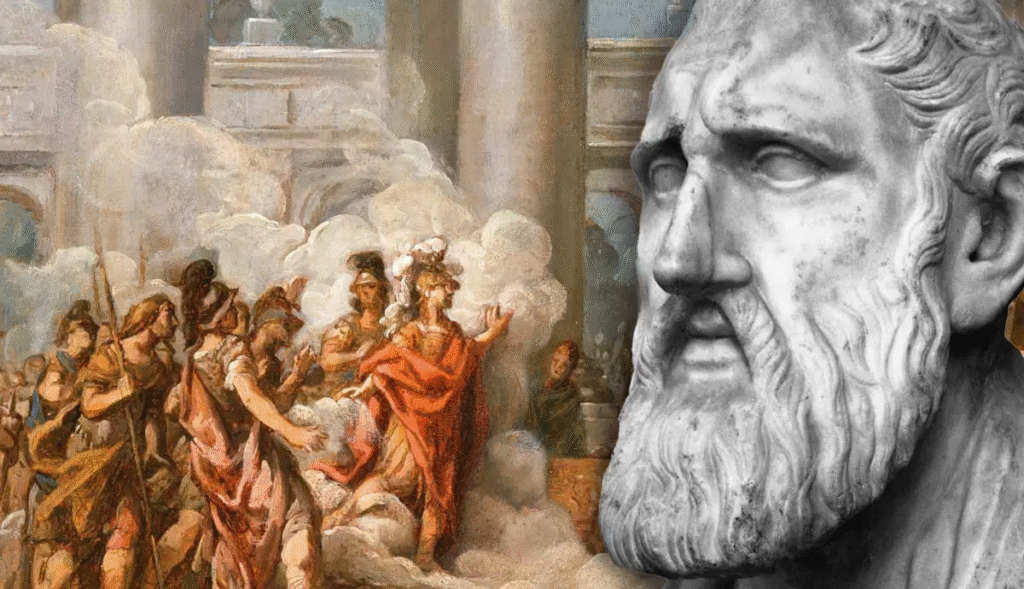
The story of Stoicism begins not in the halls of power or the temples of Greece but in a bustling Athenian marketplace, where a shipwrecked merchant from Cyprus found his destiny. That man was Zeno of Citium, the founder of one of the most influential schools of ancient philosophy. His ideas, born in the turmoil of the Hellenistic age, would shape the moral outlook of the Roman Empire and echo through Western thought for more than two thousand years.
Zeno’s life and teaching show how philosophy can grow from hardship. His school taught endurance, reason, and harmony with nature. It became a way of living rather than a doctrine to memorize. To understand Stoicism, one must begin with the man who gave it its form and purpose.
A Merchant Turned Philosopher
Zeno was born around 334 BCE in Citium, a city on the island of Cyprus. His father was a merchant who traded with Athens and brought home books of philosophy. These early readings introduced young Zeno to the world of Greek thought. For much of his early life, he followed his father’s trade, sailing the Mediterranean as a merchant. But a shipwreck near Athens changed the course of his life.
According to ancient accounts, Zeno lost everything when his ship went down. Stranded in Athens with nothing but his curiosity, he entered a bookseller’s shop and began reading Xenophon’s Memorabilia, a dialogue about Socrates. Impressed by the portrait of the wise and self-controlled philosopher, Zeno asked where such men could be found. The bookseller pointed to the philosopher Crates of Thebes, a well-known Cynic who happened to be walking by. Zeno followed him and became his student.
That encounter began a transformation. The merchant who once dealt in goods now began to trade in ideas. Zeno studied with several philosophers, absorbing the teachings of the Cynics, the Megarians, and the followers of Plato. Over time, he developed his own synthesis, combining practical ethics with a rational understanding of the universe.
The Painted Stoa
Around 300 BCE, Zeno of citium began teaching in Athens at the Stoa Poikile, or “painted colonnade,” a public portico decorated with murals of heroic scenes. From this location, his followers came to be known as Stoics. Unlike the secluded gardens of Epicurus, the Stoa stood at the heart of civic life. This reflected Zeno’s belief that philosophy should not withdraw from the world but engage with it.
Zeno’s school soon gained respect in Athens. His students admired his calm and modest character. He lived simply, ate sparingly, and avoided luxury. The Athenians came to regard him as a model of integrity. According to tradition, they honored him with a golden crown and a public burial. Though little of his original writing survives, his ideas were preserved by later Stoics such as Chrysippus, Seneca, and Marcus Aurelius.
The Structure of Stoic Philosophy
Zeno organized philosophy into three parts: logic, physics, and ethics. These corresponded to the structure of the human mind and the cosmos. Logic trained reason to recognize truth. Physics explained the natural order of the universe. Ethics taught how to live in harmony with that order. Together they formed a unified system aimed at wisdom.
Logic, for Zeno, was more than formal reasoning. It included the study of knowledge and the nature of perception. He believed that human beings possess a rational faculty capable of grasping reality through clear impressions. False judgments arise when we assent to impressions that are uncertain or distorted. Philosophy, therefore, begins with the discipline of assent—learning to give the mind’s approval only to what is evident and consistent.
Physics, in Zeno’s view, described a universe governed by divine reason, or logos. The cosmos is a living being, ordered and purposeful. Everything that happens follows from this rational structure. Nothing occurs by chance. Fire, representing the creative spirit, is the active principle that shapes matter into form. God, nature, and reason are not separate entities but different names for the same universal order.
Ethics was the heart of the system. If the world is rational, then human happiness lies in living according to reason. Virtue is the only true good because it alone depends on our will. Health, wealth, and social standing are “indifferent” things—they may be preferred or avoided, but they do not define moral worth. The wise person seeks to align his desires with nature’s law, accepting whatever happens as part of the whole.
The Stoic Sage
Zeno’s vision of the ideal person was the sage: calm, rational, and self-sufficient. The sage possesses complete understanding and therefore complete freedom. His emotions are not suppressed but transformed. Instead of fear, he feels caution; instead of anger, reasoned concern. He desires nothing contrary to nature and accepts all outcomes with serenity.
This ideal was demanding, and even the Stoics admitted that few, if any, ever reached it fully. Yet the pursuit of wisdom itself was worthwhile. The effort to live rationally, to examine one’s judgments and master one’s impulses, could bring peace even amid turmoil. In this sense, Zeno made philosophy practical, a daily discipline of self-examination and moral clarity.
The Influence of Socrates and the Cynics
Zeno drew heavily from earlier schools, especially the teachings of Socrates and the Cynics. From Socrates he inherited the belief that virtue is knowledge and that no one does wrong knowingly. From the Cynics he learned simplicity and independence from material possessions. Yet he softened the harshness of Cynicism.
The Cynics rejected social institutions and lived in deliberate poverty. Zeno, by contrast, believed that the wise person could live within society while maintaining inner freedom. He accepted duties to family and city as expressions of natural reason. For him, virtue did not require withdrawal from the world but right participation in it. This balance between detachment and engagement became a hallmark of Stoicism.
The Community of Reason
One of Zeno’s most original ideas was his concept of universal brotherhood. He taught that all human beings share in divine reason and therefore belong to a single community. This vision transcended the boundaries of city and nation. While other Greeks divided humanity into citizens and foreigners, Zeno imagined a world-state governed by reason.
This cosmopolitan outlook had lasting influence. It inspired later Stoics, who taught that every person is a citizen of the cosmos. The idea of a universal moral law grounded in reason would later shape Roman law and Christian ethics. Zeno’s philosophy thus laid the groundwork for the concept of human equality.
Emotion and the Life of the Soul
Zeno’s treatment of emotion was one of his most distinctive contributions. He taught that emotions arise from false judgments. When we fear death or grieve loss, we reveal a mistaken belief that these events are evils. The wise person recognizes that such things are natural and inevitable. By correcting judgment, we can attain tranquility.
This does not mean indifference to life or others. Rather, it means understanding the proper place of feelings. Compassion, affection, and gratitude can exist within the framework of reason. What Stoicism seeks is freedom from passion in its destructive form, not from emotion altogether. The mind, guided by understanding, remains calm amid joy and sorrow alike.
Daily Practice and Discipline
For Zeno of citium and his followers, philosophy was not an abstract pursuit but a form of spiritual exercise. They practiced daily reflection, examined their conscience, and trained their attention on the present moment. They studied logic to sharpen judgment and meditated on the order of the cosmos to strengthen faith in reason.
Self-control, moderation, and endurance were cultivated through habit. Zeno encouraged his students to simplify their lives and to face hardship without complaint. He himself lived with great austerity, sleeping on the floor and eating plain food. His example gave Stoicism its moral authority.
Zeno’s Successors
Zeno’s immediate followers included Cleanthes, who succeeded him as head of the Stoa, and Chrysippus, who developed Stoicism into a systematic philosophy. Cleanthes wrote hymns to Zeus that expressed the Stoic belief in divine reason pervading the world. Chrysippus, a thinker of immense energy, expanded Stoic logic and ethics, establishing the doctrines that later Stoics would inherit.
Through these successors, Zeno’s ideas spread throughout the Hellenistic world. By the time Rome absorbed Greece, Stoicism had become one of the dominant schools of philosophy. Roman thinkers admired its emphasis on virtue, rationality, and civic duty. Other stoic philosophers, such as Seneca, Epictetus, and Marcus Aurelius carried Zeno’s legacy into new eras, interpreting his teachings for their own times.
The Character of the Founder
Ancient biographers describe Zeno as a man of calm dignity. He spoke little and lived modestly. His humor was dry, his will steady. Though his early life had been marked by loss, he showed no bitterness. When praised for his frugality, he replied that he preferred to conquer luxury rather than be conquered by it.
According to legend, he died around 262 BCE at the age of seventy-two. When he stumbled and broke a finger, he interpreted it as a sign that his time had come. He withdrew from life by holding his breath, an act the ancients viewed as rational acceptance of fate rather than despair. The Athenians honored him with a public tomb, a rare distinction for a foreigner.
The Spirit of Early Stoicism
Zeno’s philosophy was born in a world of transition. The old city-states of Greece had lost independence after the conquests of Alexander the Great. People now lived in vast empires rather than small communities. In this new world, individuals sought meaning in personal virtue rather than civic glory. Stoicism answered that need. It offered an inner fortress of reason amid the uncertainties of history.
Zeno’s message was simple yet demanding. The universe is governed by order, and wisdom consists in aligning oneself with it. The source of peace is not external success but harmony with nature. By living according to reason, one becomes free from the tyranny of circumstance.
Lasting Influence
Though few of Zeno’s writings survive, his influence endures through the Stoic tradition. The moral strength of his teaching appealed to Romans, Christians, and modern thinkers alike. His emphasis on rational self-control inspired later philosophers such as Descartes and Spinoza, and his vision of universal brotherhood foreshadowed ideas of natural law and human rights.
Modern revivals of Stoicism continue to draw on Zeno’s insights. The practice of focusing on what can be controlled and accepting what cannot reflects his original division between things within our power and those beyond it. His insistence that philosophy must serve life, not merely describe it, remains one of his most important lessons.
Conclusion
Zeno of Citium, one of the stoic philosophers, stands at the beginning of a long tradition that taught humanity how to live with reason, courage, and compassion. Out of personal loss, he built a philosophy of resilience. Out of the confusion of his age, he created a vision of order. He taught that virtue is the only wealth that cannot be taken away and that peace of mind comes from living in harmony with nature’s law.
His school at the painted Stoa gave the world more than doctrines. It gave an example of how wisdom can shape character. Through Zeno’s influence, philosophy became not an escape from life but a means of mastering it. His teaching that all people share in divine reason established a foundation for moral equality and respect that continues to resonate.
The merchant from Citium who once sought fortune at sea found instead a treasure that time could not erode: the discovery that happiness lies not in what we possess but in how we think and act. Zeno’s Stoicism remains a philosophy for those who wish to live calmly in a turbulent world, guided by reason and strengthened by virtue.